
The Real Reason Your ERP Implementation Failed
The Real Reason Your ERP Implementation Failed
Monday 6th April
The Real Reason Your ERP Implementation Failed
Hint: it wasn’t the software.
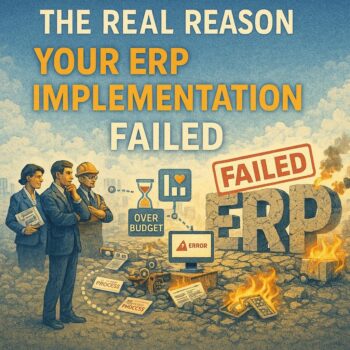
You spent $150,000 on a new ERP system. You sat through the demos. You signed the contract. You went through months of implementation, training, and disruption. And now, eighteen months later, half your team has gone back to spreadsheets and the system does little more than generate invoices.
So you call the vendor. They tell you the system is working exactly as designed. And they’re right.
That’s the part that stings.
The Vendor Is Not The Problem
Every post-mortem on a failed ERP implementation sounds the same. The software was too complex. The vendor oversold it. The consultant didn’t understand the business. The staff weren’t trained properly.
There is usually some truth in all of these. But they are symptoms, not causes.
The real reason most ERP implementations fail in manufacturing and B2B businesses is simpler and harder to hear: the business wasn’t operationally ready for it. The processes weren’t documented. The data wasn’t clean. The decision-making wasn’t clear. And nobody stopped to fix any of that before the implementation started.
An ERP system does not fix a broken process. It automates it — and broken processes automated at scale become very expensive broken processes.
What Operational Readiness Actually Means
Before any technology implementation — ERP, CRM, WMS, or otherwise — a business needs to be able to answer three questions clearly:
- How does work actually flow through this business, from order to delivery?
- Where are the decisions made, and who owns them?
- What does ‘good’ look like, and how are we currently measuring it?
Most businesses cannot answer these questions with any precision. Not because they’re poorly run — but because this kind of operational clarity is rarely built deliberately. It evolves, informally, over years. It lives in people’s heads. And it only becomes a problem when you try to systematise it.
That is exactly when the ERP project stalls. Not because the software can’t handle the complexity, but because nobody can agree on how the business actually works.
The $200K Lesson Most Owners Learn Too Late
Consider a composite picture that is familiar to anyone who has worked in manufacturing or distribution at scale.
A business turns over $12M. They’ve been running a patchwork of spreadsheets, a basic accounting system, and a handful of workarounds held together by institutional memory. It has worked, more or less, until now.
The owner decides the business has outgrown its systems and invests in a mid-market ERP. The vendor scopes the project based on what the business says it does. Implementation begins.
Six months in, the project is three months behind and $60,000 over budget. The reason? The business discovered, mid-implementation, that three different people had three different versions of how the order fulfilment process worked. None of them were wrong. They had each developed their own approach over time, and nobody had ever needed to reconcile them — until now.
That reconciliation took four months. The ERP went live eventually. But the cost of the delay, the consultant hours, and the staff time lost to the project came to more than the software itself.
The owner’s reflection afterward: “We should have sorted out our processes first. Then the implementation would have taken half the time and cost half as much.”
What To Do Before You Implement Anything
The sequence matters enormously.
Technology should be the last decision, not the first. Before you evaluate a single vendor or sit through a single demo, the business needs to go through an honest operational review. That means:
- Mapping how work actually flows — not how it’s supposed to flow
- Identifying where decisions bottleneck and why
- Documenting the processes that need to be systematised
- Cleaning and standardising the data that will feed the new system
- Getting clear on what problem the technology actually needs to solve
This is not glamorous work. It does not come with a product demo or a vendor lunch. But it is the work that determines whether your ERP project delivers a return or becomes a very expensive lesson.
If You’re Considering an ERP — Or Recovering From One
The 1-Day Operational Diagnostic is designed precisely for this moment. Whether you’re preparing for a systems overhaul or trying to understand why a recent implementation hasn’t delivered, the diagnostic gives you a clear picture of where your operations actually stand.
In a single structured day, we identify the operational gaps, bottlenecks, and misalignments that will either derail your technology project or explain why the last one underdelivered. You leave with a prioritised findings report and a roadmap that tells you what to fix, in what order, before you spend another dollar on software.
The diagnostic costs $2,000 for SEQ-based businesses and $2,500 for interstate engagements. It is, in most cases, the most cost-effective investment a business can make before committing to a six-figure technology project.
Is your business operationally ready for the technology you’re about to invest in?
The 1-Day Operational Diagnostic gives you a clear picture of where your operations stand — and a prioritised roadmap before you commit to any major systems investment. One day. A clear picture. A plan you can act on.
Drew Robins | Director, FBS Consulting Fractional COO and CRO for Australian manufacturers and B2B companies in the $2M–$40M revenue range.