
The Operations Audit: 20 Questions That Reveal Hidden Inefficiencies
The Operations Audit: 20 Questions That Reveal Hidden Inefficiencies
Monday 23rd February
The Operations Audit: 20 Questions That Reveal Hidden Inefficiencies
Your business is losing money right now. Not from competitors or market conditions—from inefficiencies you can’t see because you’re too close to the operation.
Every manufacturing and B2B business I walk into believes they run efficiently. Their team works hard. Their customers get served. Revenue comes in. But when I ask 20 specific questions, the silence tells me everything. Within minutes, we’ve identified $200,000 in hidden costs, 30% excess capacity, or critical bottlenecks that cap growth at exactly where they are today.
The difference between a $5 million business and a $10 million business isn’t always market opportunity. It’s operational efficiency. And most owners don’t know where to look.
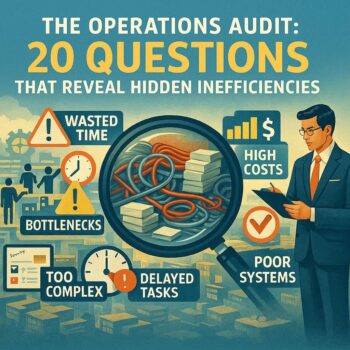
This isn’t theory. In 30+ years of operational leadership across Europe and Australia, I’ve seen the same patterns repeat: businesses working harder instead of smarter, investing in growth initiatives while haemorrhaging profit through operational leaks, and wondering why scaling feels impossible.
Here’s the truth: you can’t fix what you can’t see. But once you see it, you can’t unsee it. And that’s when transformation becomes inevitable.
Why Traditional Business Reviews Miss the Point
Most business owners conduct annual reviews. They examine:
- Financial statements (lagging indicators of past decisions)
- Sales performance (measuring symptoms, not causes)
- Customer satisfaction (important, but incomplete)
- Market position (external focus when internal systems drive results)
These reviews answer the wrong questions. They tell you what happened, not why it happened or how to prevent it recurring.
An operations audit asks different questions. Questions that expose the invisible systems determining your actual capacity, real margins, and genuine scalability. Questions that reveal whether you’re building a business that can grow or one that’s structurally capped at current performance.
I’ve conducted operational assessments in businesses generating $2 million to $50 million in revenue. The size changes. The questions don’t. Because operational inefficiency follows predictable patterns, regardless of industry or scale.
The Real Cost of Operational Inefficiency
Before we dive into the assessment framework, let’s establish what’s actually at stake.
A $5 million manufacturer operating at 70% efficiency doesn’t have an efficiency problem. They have a $1.5 million profit problem. That 30% inefficiency translates directly into:
- Excess labour costs (people working harder, not smarter)
- Unnecessary overtime (compensating for poor planning)
- Inventory carrying costs (buffer stock hiding supply chain issues)
- Quality failures (rework masking process problems)
- Delivery delays (operational constraints disguised as customer issues)
- Lost sales (capacity limitations preventing growth)
I recently worked with a Gold Coast modular construction company transitioning from traditional building to manufacturing processes. On paper, they had capacity to double production. In reality, their operational systems could barely support current volume. Materials arrived late because purchasing worked reactively. Production stopped daily for missing components. Quality checks happened too late to prevent costly rework. Customer experience suffered because internal chaos created external inconsistency.
The financial impact? Roughly $400,000 in annual operational waste. Not from incompetent people or poor intentions—from systems that evolved organically without strategic design.
Within 90 days of implementing systematic operational improvements, they unlocked 40% additional capacity without hiring anyone or buying equipment. They simply stopped working around broken processes and fixed them instead.
This is typical. Most businesses operate 20-40% below their true capacity, not because they lack resources, but because their operational systems haven’t been intentionally designed for efficiency.
How to Use This Assessment Framework
The 20 questions below are organised into five critical operational dimensions:
- Process Efficiency (Questions 1-4)
- Resource Utilisation (Questions 5-8)
- Information Flow (Questions 9-12)
- Quality Systems (Questions 13-16)
- Scalability Readiness (Questions 17-20)
Here’s how to approach this audit:
For each question, rate your business honestly on a 1-5 scale:
- 1 = Major concern (we don’t do this, or do it very poorly)
- 2 = Significant gap (we attempt this but with poor consistency)
- 3 = Adequate (we do this reasonably well, with room for improvement)
- 4 = Strong (we do this well with minor gaps)
- 5 = Excellent (we do this systematically with documented processes)
Be brutally honest. This isn’t about feeling good—it’s about identifying opportunities. A business scoring 3 across all questions isn’t “adequate.” It’s leaving significant value on the table.
Scoring interpretation:
- 80-100: Operationally excellent (rare, even among successful businesses)
- 60-79: Solid foundation with specific improvement opportunities
- 40-59: Significant operational drag limiting growth potential
- Below 40: Critical inefficiencies requiring immediate attention
Most businesses I assess score 45-65. They’re successful despite operational inefficiency, not because of operational excellence. Which means massive upside exists when they address the gaps.
Now, let’s begin.
Dimension 1: Process Efficiency
Question 1: Can you produce your product or deliver your service the same way, every time, regardless of who’s doing the work?
What this reveals: Process documentation and standardisation.
If the answer depends on which team member is working, you don’t have a process—you have talented people compensating for the absence of systems. This creates:
- Inconsistent quality (customer experience varies by who serves them)
- Training difficulties (no standard to teach against)
- Bottlenecks around key people (knowledge trapped in individuals)
- Scalability limits (can’t grow beyond current team capacity)
Red flag indicators:
- “Dave’s the only one who knows how to do that”
- Quality varies noticeably between team members
- New employees take months to reach full productivity
- You avoid certain jobs when key people are unavailable
What good looks like: Documented standard operating procedures for every repeatable process. New employees can reference these documents and achieve 80% productivity within their first month. Quality variation between team members is minimal and measurable.
Question 2: Do you know your actual capacity versus your theoretical capacity, and what’s consuming the difference?
What this reveals: Understanding of operational constraints and waste.
Most businesses know their theoretical capacity (equipment specs, available hours, team size). Few know their actual capacity (what they consistently produce). Almost none can explain the gap.
That gap contains your hidden profit.
Typical capacity consumers:
- Changeover time (switching between products/jobs)
- Material shortages (production stopping for missing components)
- Equipment downtime (maintenance, breakdowns, adjustments)
- Quality issues (rework consuming productive capacity)
- Poor scheduling (waiting time between jobs)
Red flag indicators:
- “We’re always flat out but never seem to catch up”
- Frequent overtime despite underutilised regular hours
- Can’t explain why last month’s volume was 30% lower than the month before
- Equipment sits idle for reasons you can’t quantify
What good looks like: You track actual capacity utilisation weekly. You know exactly what’s consuming the difference between theoretical and actual capacity. You have systematic improvement initiatives targeting the biggest gaps.
Question 3: How long does it take to move from customer order to delivery, and can you reduce that time by 30% without additional resources?
What this reveals: Process cycle time and improvement potential.
Long cycle times indicate:
- Waiting time between process steps (batch processing, queue management issues)
- Excessive handling (products moving through unnecessary steps)
- Information delays (decisions waiting for approvals or data)
- Poor coordination (departments working in silos)
I’ve yet to assess a business where we couldn’t reduce cycle time by at least 20% through process optimisation alone. Usually, 30-40% reduction is achievable within 90 days.
Red flag indicators:
- Standard delivery times of 6-8 weeks when actual work time is 3-5 days
- Jobs sitting between process steps for days
- Rush orders that prove normal orders could move faster
- You can’t explain where time goes between order and delivery
What good looks like: You’ve mapped the entire process from order to delivery. You know where time is spent versus where it’s wasted. You have specific initiatives to reduce non-value-adding time.
Question 4: Do you regularly review and improve your processes, or do they remain static year after year?
What this reveals: Continuous improvement culture.
Static processes guarantee declining competitiveness. Markets evolve. Technology improves. Competitors innovate. If your processes look the same as they did three years ago, you’re falling behind.
Red flag indicators:
- “We’ve always done it this way” is a common phrase
- No formal process improvement meetings or initiatives
- Last significant process change was years ago
- Team members can’t recall recent improvements they’ve implemented
What good looks like: Monthly process improvement reviews. Clear ownership for improvement initiatives. Documented changes with measurable impact. Team members actively identify and solve inefficiencies.
Dimension 2: Resource Utilisation
Question 5: Can you see your operational performance in real-time, or do you discover problems after they’ve impacted customers?
What this reveals: Visibility and control systems.
If you discover production problems on Friday afternoon, quality issues when customers complain, or delivery delays after they’ve occurred, you’re operating reactively. You’re managing consequences instead of preventing problems.
Critical metrics requiring real-time visibility:
- Production output versus plan (daily, ideally hourly)
- Quality metrics (defect rates, first-pass yield)
- On-time delivery performance
- Resource utilisation (people, equipment, materials)
- Cash flow position
Red flag indicators:
- Monthly financial statements are your primary performance feedback
- You discover problems from customer complaints
- Weekly production meetings start with “I didn’t realise we were behind”
- No daily operational metrics dashboard
What good looks like: Daily operational dashboards showing key performance indicators. Problems are visible within hours, not weeks. Team members can explain current performance versus targets without checking reports.
Question 6: Is your team working on what matters most, or constantly firefighting urgent issues?
What this reveals: Planning effectiveness and operational stability.
If your team spends most days in reactive mode, you don’t have an urgency problem—you have a planning problem. Constant firefighting indicates:
- Poor planning systems (work released without proper preparation)
- Inadequate preventive maintenance (equipment failures creating emergencies)
- Insufficient inventory management (material shortages stopping production)
- Lack of contingency planning (every variation becomes a crisis)
Red flag indicators:
- Most days feel chaotic despite everyone working hard
- Planned work regularly gets displaced by urgent issues
- Team members can’t complete tasks because they’re constantly interrupted
- “Crisis management” is considered normal
What good looks like: 80% of work happens as planned. Unplanned issues are exceptions, not the norm. Team members complete planned work without constant disruption. Root cause analysis prevents recurring problems.
Question 7: Do you know which products, customers, or services actually make you money versus those subsidised by the profitable ones?
What this reveals: Product/customer profitability understanding.
Revenue isn’t profit. Many businesses serve unprofitable customers without realising it, subsidising their losses with profitable business. This creates:
- False growth (revenue increases while profit stagnates)
- Resource misallocation (effort focused on low-value work)
- Strategic confusion (defending business that destroys value)
I’ve worked with businesses where 40% of their customers generated 95% of their profit, while 30% of customers actually lost money when fully costed. They were working harder to serve unprofitable business, wondering why growth didn’t improve profitability.
Red flag indicators:
- You price based on competition or cost-plus without understanding true profitability
- Some customers require disproportionate support or special handling
- You can’t explain why profit margins vary significantly between jobs
- Gross margin and net margin tell very different stories
What good looks like: You know exactly which products, customers, and services are profitable. You make strategic decisions about resource allocation based on profitability data. Pricing reflects true cost to serve.
Question 8: Could your operation continue effectively if a key person was unavailable for three months?
What this reveals: Knowledge concentration risk.
Businesses built around key people are fragile. When critical knowledge exists only in someone’s head, you face:
- Succession risk (business value depends on individuals)
- Scaling limits (can’t grow beyond key people’s capacity)
- Decision bottlenecks (everything waits for the expert)
- Catastrophic failure potential (illness, departure, or unavailability creates crisis)
Red flag indicators:
- Certain jobs can only be done by specific people
- Key person holiday creates operational stress
- Training new people takes 6-12 months because nothing’s documented
- You panic when thinking about someone leaving
What good looks like: Critical knowledge is documented and transferable. Multiple people can perform essential functions. Individual absence is inconvenient, not catastrophic. Succession planning exists for key roles.
Dimension 3: Information Flow
Question 9: Does information flow seamlessly through your operation, or does it get trapped, delayed, or distorted?
What this reveals: Communication and information systems.
Poor information flow manifests as:
- Decisions made on outdated data
- Duplicate data entry creating errors
- Different departments working from different information
- Critical information discovered too late to act
I’ve seen businesses where production worked to last month’s schedule because sales changes weren’t communicated. Purchasing ordered materials for cancelled jobs because no one told them. Customers received incorrect information because systems weren’t integrated.
Red flag indicators:
- “I didn’t know that” is a common phrase
- Different people give different answers to the same question
- Information exists but people can’t access it easily
- Decisions get delayed waiting for information someone already has
What good looks like: Single source of truth for critical information. Real-time visibility across departments. Information automatically flows to those who need it. Minimal manual information transfer.
Question 10: Can you make informed decisions quickly, or does analysis paralysis slow everything down?
What this reveals: Decision-making effectiveness.
Slow decisions cost money. But so do fast decisions made without adequate information. The question isn’t about speed alone—it’s about having the right information available when decisions need to be made.
Red flag indicators:
- Decisions delayed because required information isn’t readily available
- Important decisions made based on gut feel because data doesn’t exist
- Analysis takes weeks for decisions that should take days
- Decisions get revisited because information was incomplete
What good looks like: Clear decision rights (who decides what). Standard information requirements for common decisions. Quick access to decision-supporting data. Balance between analysis and action.
Question 11: Do your teams collaborate effectively, or do departmental silos create friction and inefficiency?
What this reveals: Organisational alignment and cross-functional effectiveness.
Silos create:
- Conflicting objectives (sales promises what operations can’t deliver)
- Finger-pointing when problems occur (blame instead of problem-solving)
- Duplicate effort (different departments solving the same problem separately)
- Customer impact (internal dysfunction becoming external problems)
Red flag indicators:
- Departments blame each other when things go wrong
- Hand-offs between departments are friction points
- Cross-functional projects are painful and slow
- “That’s not my department” is heard regularly
What good looks like: Shared objectives across departments. Regular cross-functional communication. Smooth hand-offs between process steps. Collective problem-solving when issues arise.
Question 12: Are your metrics driving the right behaviours, or creating unintended consequences?
What this reveals: Performance measurement system effectiveness.
Metrics drive behaviour. Poor metrics drive poor behaviour. Common problems:
- Measuring activity instead of outcomes (busy versus productive)
- Conflicting metrics (efficiency versus quality, speed versus accuracy)
- Short-term focus (hitting monthly targets while damaging long-term performance)
- Individual metrics undermining team performance
I’ve seen businesses measure production efficiency that incentivised long runs of the same product, creating massive inventory problems. Sales targets that encouraged unprofitable business. Quality metrics that increased inspection costs without improving defect rates.
Red flag indicators:
- Team members game the metrics without improving real performance
- Hitting targets doesn’t correlate with business success
- Metrics create conflict between departments
- You measure what’s easy instead of what matters
What good looks like: Metrics aligned with strategic objectives. Balance between competing priorities. Behaviours driven by metrics support overall business performance. Regular review and adjustment of measurement systems.
Dimension 4: Quality Systems
Question 13: Do you prevent quality problems, or inspect them out after they occur?
What this reveals: Quality system maturity.
Inspection finds defects. Prevention eliminates them. The cost difference is enormous.
Quality cost hierarchy (from most to least expensive):
- External failure (customer discovers defect, returns, reputation damage)
- Internal failure (you discover defect, rework, scrap)
- Appraisal (inspection, testing, checking)
- Prevention (process design, training, mistake-proofing)
Most businesses invest heavily in appraisal and manage internal failure. Few invest systematically in prevention.
Red flag indicators:
- Rework is a normal part of operations
- Quality depends on inspection catching problems
- Defect rates haven’t improved significantly in years
- Quality is the quality department’s problem, not everyone’s responsibility
What good looks like: Quality built into processes, not inspected in. Declining defect rates year over year. First-pass yield above 95%. Quality ownership distributed across the operation.
Question 14: When problems occur, do you fix symptoms or eliminate root causes?
What this reveals: Problem-solving capability.
Symptom fixing creates recurring problems. Root cause elimination prevents recurrence. The difference:
- Symptom: Machine keeps breaking → hire a mechanic on standby
- Root cause: Machine keeps breaking → identify why and prevent failure mode
Red flag indicators:
- Same problems keep occurring
- “We fixed that before” is a common phrase
- Solutions are temporary workarounds
- No systematic root cause analysis process
What good looks like: Formal root cause analysis for significant problems. Declining frequency of recurring issues. Preventive actions implemented, not just corrective. Learning captured and shared.
Question 15: Do you have early warning systems that detect small problems before they become large ones?
What this reveals: Monitoring and feedback loops.
Small problems ignored become large crises. Early warning systems provide:
- Leading indicators (trends before they become problems)
- Threshold alerts (notifications when metrics exceed acceptable ranges)
- Pattern recognition (anomalies indicating potential issues)
Red flag indicators:
- Problems discovered after they’ve escalated
- No monitoring between scheduled reviews
- Surprised by issues that developed gradually
- Reactive management instead of proactive prevention
What good looks like: Automated monitoring of critical parameters. Clear escalation protocols when thresholds are exceeded. Regular trend analysis identifying developing issues. Problems addressed early in small stages.
Question 16: Can you trace any product back through your entire supply chain and production process?
What this reveals: Traceability and accountability systems.
Traceability enables:
- Quality problem isolation (identifying exactly what’s affected)
- Root cause analysis (connecting outcomes to specific inputs or processes)
- Compliance demonstration (proving processes were followed)
- Continuous improvement (linking performance to specific conditions)
Red flag indicators:
- Can’t identify which batch of materials went into which products
- Quality problems require investigating everything, not specific items
- No way to trace products back to production conditions
- Compliance is based on trust, not verification
What good looks like: Complete traceability from raw materials through delivery. Batch tracking enabling precise problem isolation. Quality data linked to specific production conditions. Rapid response capability when issues are identified.
Dimension 5: Scalability Readiness
Question 17: If sales doubled next quarter, could your operations handle it without chaos?
What this reveals: Operational capacity and flexibility.
Most businesses can’t scale smoothly because:
- Processes designed for current volume break at higher volume
- Systems require manual intervention that doesn’t scale
- Key resources become bottlenecks
- Planning and coordination systems can’t handle increased complexity
Red flag indicators:
- Growth creates operational stress and quality problems
- “We’re too busy to take on more work” despite wanting growth
- Scaling requires proportional staff increases
- Process workarounds increase with volume
What good looks like: Documented capacity constraints and bottlenecks. Planned approach to scaling operations. Systems and processes designed to handle volume variation. Growth doesn’t degrade quality or delivery performance.
Question 18: Are your operational processes documented sufficiently to onboard new team members quickly and effectively?
What this reveals: Knowledge transfer and training systems.
Undocumented processes mean:
- Long training periods (6-12 months to full productivity)
- Inconsistent training (depends on who teaches)
- Knowledge loss (departing employees take critical information)
- Scaling difficulty (can’t rapidly expand team)
Red flag indicators:
- New employees take months to become productive
- Training is “follow Dave around for a few weeks”
- Different people teach processes differently
- No standard training materials or checklists
What good looks like: Comprehensive process documentation. Structured training programs. New employees reach 80% productivity within 4-6 weeks. Consistent onboarding experience regardless of trainer.
Question 19: Do you invest systematically in improving operational capability, or only react when problems force change?
What this reveals: Continuous improvement commitment.
Reactive businesses slowly decline. Proactive businesses continuously improve. The difference:
- Reactive: Fix equipment when it breaks
- Proactive: Maintain equipment to prevent breakdowns
- Reactive: Hire when overloaded
- Proactive: Improve efficiency to increase capacity
- Reactive: Change when forced by crisis
- Proactive: Improve because better is always possible
Red flag indicators:
- Improvement projects only happen during crises
- No budget for operational improvement
- Years between significant process updates
- Improvement driven by problems, not opportunity
What good looks like: Regular investment in operational improvement. Scheduled process reviews and updates. Team time allocated for improvement projects. Continuous improvement culture embedded in operations.
Question 20: Can you articulate your operational constraints and what you’re doing to eliminate them?
What this reveals: Strategic operational thinking.
Every operation has constraints limiting performance. The question is whether you:
- Know what they are
- Understand their impact
- Have plans to address them
Theory of Constraints principle: Every system has one primary constraint limiting performance. Improving anything other than the constraint doesn’t improve overall performance.
Red flag indicators:
- Can’t identify your primary operational bottleneck
- Invest in improvements that don’t address constraints
- Surprised when volume increases don’t improve profit
- No systematic constraint identification and elimination process
What good looks like: Clear understanding of operational constraints. Focused improvement efforts on constraint elimination. Measurable capacity increases as constraints are addressed. Sequential approach to constraint management.
Interpreting Your Results
Now that you’ve answered all 20 questions, let’s analyse what they reveal about your operational health.
Calculate your total score (add up all ratings from 1-5 across the 20 questions):
80-100: Operationally Excellent Your operations are among the best I’d expect to see in Australian manufacturing and B2B businesses. You have systematic processes, strong visibility, and continuous improvement embedded in your culture. Your focus should be on maintaining excellence and identifying specific opportunities for competitive advantage through operational innovation.
60-79: Solid Foundation with Opportunity You have good operational fundamentals but significant upside potential. Likely, some dimensions are strong (perhaps 4s and 5s) while others drag down overall performance (2s and 3s). This uneven performance indicates specific, addressable opportunities. Focus on your lowest-scoring dimension first—this is likely your primary constraint limiting overall performance.
40-59: Operational Drag Limiting Growth Your operations are holding back business potential. You’re successful despite operational inefficiency, which means you’re leaving substantial profit and growth opportunity unrealised. The good news: improvement potential is enormous. Systematic operational improvement could unlock 20-40% additional capacity, significantly reduce costs, and enable sustainable growth without proportional resource increases.
Below 40: Critical Inefficiency Requiring Immediate Attention Your operations require urgent intervention. Current success depends on talented people working around broken systems, which is neither sustainable nor scalable. You face significant risk if key people become unavailable. Growth attempts will likely increase chaos rather than profit. Priority should be stabilising core operations before attempting expansion.
Dimension-Specific Analysis
Beyond overall score, examine your performance by dimension:
If Process Efficiency (Questions 1-4) scored lowest: Your primary issue is process design and documentation. Processes exist informally in people’s heads rather than formally in documented systems. This creates inconsistency, knowledge concentration risk, and scaling limitations. Priority actions:
- Document your core processes
- Standardise approaches across team members
- Implement continuous improvement reviews
- Map value streams to identify waste
If Resource Utilisation (Questions 5-8) scored lowest: You’re not maximising value from existing resources. People, equipment, and capital are underutilised or misallocated. This typically indicates poor planning, inadequate visibility, or misalignment between capacity and demand. Priority actions:
- Implement daily operational dashboards
- Improve planning and scheduling systems
- Analyse capacity utilisation systematically
- Address key person dependencies
If Information Flow (Questions 9-12) scored lowest: Communication and information systems are creating friction and delay. Information doesn’t reach the right people at the right time, or gets distorted in transmission. This slows decisions and creates coordination problems. Priority actions:
- Map information flows through your operation
- Eliminate information silos
- Improve cross-functional communication
- Align metrics with strategic objectives
If Quality Systems (Questions 13-16) scored lowest: Quality is managed through inspection and correction rather than prevention. This is expensive and creates customer risk. You’re likely experiencing recurring problems without systematic root cause elimination. Priority actions:
- Shift from inspection to prevention
- Implement root cause analysis
- Build quality into processes
- Develop early warning systems
If Scalability Readiness (Questions 17-20) scored lowest: Your operations are optimised for current volume but won’t scale effectively. Growth attempts will create stress, quality problems, and potentially customer dissatisfaction. Priority actions:
- Document processes for transferability
- Identify and address operational constraints
- Build operational flexibility
- Invest in systematic improvement capability
Common Patterns I See in Australian SME Manufacturers
After three decades of operational leadership and years specifically working with Australian manufacturers and B2B businesses in the $2M-$20M revenue range, certain patterns emerge consistently:
Pattern 1: The Founder Bottleneck Scores typically lowest on Questions 8, 18, and 20. The business was built around the founder’s expertise and hasn’t transitioned to systematic, transferable processes. Growth is capped at the founder’s personal capacity to maintain oversight. Operations depend on key people whose knowledge isn’t documented or distributed.
Pattern 2: The Reactive Operations Trap Scores lowest on Questions 6, 14, and 19. The business operates in constant firefighting mode. Every day brings new crises. Root causes never get addressed because there’s no time—everyone’s too busy fixing symptoms. Improvement happens only when forced by major problems, not proactively.
Pattern 3: The Visibility Gap Scores lowest on Questions 5, 9, and 15. Management doesn’t have real-time operational visibility. Problems are discovered after they’ve impacted customers. Decisions get made on outdated information or gut feel. Performance metrics lag reality by weeks or months.
Pattern 4: The Profitable Chaos Reasonably high scores on Quality and Scalability, but low on Process Efficiency and Resource Utilisation. The business delivers good products and serves customers well, but does so inefficiently. Success depends on talented people working around disorganised systems. Profit margins are lower than they should be. Capacity is constrained despite apparent resources.
Pattern 5: The Illusion of Efficiency Scores look reasonable across most dimensions (3s and 4s), but Questions 2, 7, and 20 score very low. The business appears efficient but doesn’t understand its actual capacity, true profitability by customer/product, or operational constraints. Revenue grows but profit doesn’t. Working harder doesn’t translate to better results.
Which pattern describes your business?
What To Do Next: From Assessment to Action
You’ve identified gaps. Now what?
Step 1: Prioritise ruthlessly You can’t fix everything simultaneously. Focus creates results. Diffused effort creates frustration. Identify your single biggest operational constraint—the one dimension or question where improvement would have the most significant business impact.
Use this prioritisation framework:
- Impact: How much would improvement affect profit, capacity, or growth?
- Difficulty: How complex is the improvement to implement?
- Risk: What happens if this isn’t addressed?
- Dependencies: What else depends on fixing this?
Step 2: Set measurable targets Vague improvement intentions fail. Specific, measurable targets drive accountability. For your priority area, define:
- Current state: Quantify the problem (cycle time, capacity utilisation, defect rate, etc.)
- Target state: Define success specifically (reduce cycle time by 30%, increase capacity to X units, achieve Y% first-pass yield)
- Timeline: When will you achieve this? (90 days is realistic for most operational improvements)
- Measurement: How will you track progress? (daily, weekly metrics)
Step 3: Identify quick wins Major transformation takes time. Quick wins build momentum and demonstrate that improvement is possible. Look for:
- High-impact, low-complexity improvements
- Changes you can implement within 2-4 weeks
- Visible results that engage the team
- Problems where solutions are known but not implemented
Step 4: Build systematic improvement capability One-off improvements help. Continuous improvement capability transforms. Develop:
- Regular improvement reviews (weekly or monthly)
- Clear ownership for improvement initiatives
- Documented processes and lessons learned
- Team engagement in identifying and solving problems
Step 5: Address knowledge and skill gaps Operational excellence requires capability. If your team lacks specific skills in process improvement, root cause analysis, or operational planning, invest in development. This might mean training, external expertise, or both.
The 90-Day Operational Transformation
In my work with Australian manufacturers and B2B businesses, I typically structure operational improvements as 90-day engagements. Why 90 days?
- Long enough: To achieve meaningful, measurable results
- Short enough: To maintain focus and momentum
- Practical timeframe: For balancing improvement work with operational demands
- Proof of concept: Demonstrates whether the approach works before longer-term commitment
A typical 90-day operational transformation addresses:
Weeks 1-2: Assessment and Planning
- Detailed operational audit (beyond these 20 questions)
- Constraint identification
- Quick win opportunities
- Improvement roadmap and targets
Weeks 3-6: Foundation Building
- Process documentation
- Visibility systems (dashboards, metrics)
- Quick wins implementation
- Team engagement and training
Weeks 7-10: Core Improvements
- Primary constraint addressed
- System implementations
- Process redesign
- Capability building
Weeks 11-12: Stabilisation and Handover
- Results measurement and validation
- Sustainability mechanisms
- Ongoing improvement framework
- Knowledge transfer
Typical outcomes from 90-day engagements:
- 20-40% capacity increase without capital investment
- 15-30% reduction in operational costs
- Measurable quality improvements
- Documented, transferable processes
- Team capability to continue improvement independently
This isn’t theoretical. I’ve delivered these results repeatedly across different industries and business sizes.
Why Most Businesses Don’t Fix What They Know Is Broken
If operational improvement is this valuable, why don’t more businesses do it?
I’ve identified five common barriers:
Barrier 1: “We’re too busy” The businesses that most need operational improvement are typically too busy firefighting to invest time fixing root causes. They’re trapped in a reactive cycle where chaos prevents the improvement that would eliminate chaos.
Reality: You can’t afford not to. Every week of delay costs money. The ROI on operational improvement is typically measured in weeks, not years.
Barrier 2: “We don’t know where to start” Operational improvement can feel overwhelming. Multiple problems competing for attention. No clear prioritisation. Fear of making things worse.
Reality: Start with constraint identification. Focus on the one thing limiting overall performance. Sequential improvement is more effective than simultaneous initiatives.
Barrier 3: “Our business is different” Every business believes their situation is unique. Special circumstances. Industry-specific challenges. Standard approaches won’t work for them.
Reality: Operational principles are universal. Industries differ. Products differ. But process efficiency, resource utilisation, information flow, quality systems, and scalability challenges follow consistent patterns.
Barrier 4: “We can’t afford external help” Businesses delay improvement because they perceive external expertise as expensive. They’ll attempt DIY improvement that takes years and delivers minimal results rather than invest in accelerated capability.
Reality: Poor operations cost far more than expert intervention. A $5M business operating at 70% efficiency loses $1.5M annually. If expert help costs $50K to unlock even half that lost value, the ROI is 750% in year one alone. Plus, the improvements compound over time.
Barrier 5: “We tried improvement before and it didn’t work” Past experience with failed improvement initiatives creates cynicism. Consultants who deliver PowerPoint recommendations without implementation support. Internal initiatives that fizzled out. Change management that disrupted operations without delivering results.
Reality: Most improvement failures stem from poor implementation, not poor diagnosis. The difference between transformation and frustration is hands-on, embedded support that delivers results alongside team development.
The Value of Professional Operational Assessment
This self-assessment provides valuable insights. But it has limitations.
What self-assessment reveals:
- Awareness of gaps
- Relative strengths and weaknesses across dimensions
- Priority areas requiring attention
- Starting point for improvement
What self-assessment can’t reveal:
- Exact quantification of opportunity (how much capacity, cost reduction, or profit improvement is achievable)
- Root causes of operational inefficiency (symptoms are visible, underlying causes often aren’t)
- Optimal improvement sequence (which changes unlock others)
- Implementation approach (how to actually transform operations)
- Hidden constraints (problems you don’t know to look for)
Professional operational assessment adds:
Deep operational analysis beyond surface-level questions. Value stream mapping. Capacity analysis. Constraint identification. Waste quantification. Financial impact modelling.
External perspective that sees what you can’t because you’re inside the business. Pattern recognition from experience across hundreds of operations. Objectivity unconstrained by internal politics or historical precedent.
Implementation roadmap that balances quick wins with sustainable transformation. Sequenced improvements. Resource requirements. Risk mitigation. Measurable milestones.
Embedded support that doesn’t just recommend but implements alongside your team. Hands-on problem-solving. Real-time adjustment. Skill transfer. Accountability for results.
Measurable outcomes delivered in 90 days, not 12 months. Capacity increases. Cost reductions. Quality improvements. Process documentation. Team capability development.
Conclusion: Operational Excellence Is a Choice, Not an Accident
You’ve completed the assessment. You’ve identified gaps. You understand what’s holding your business back.
Now you face a choice.
Option 1: Do nothing Continue operating as you have been. Accept current performance as “good enough.” Leave hidden capacity unrealised and operational waste unaddressed. Hope that working harder will somehow produce different results.
Option 2: DIY improvement Attempt to fix operational issues internally. Allocate time (that doesn’t exist) to improvement projects. Learn through trial and error. Make progress slowly, if at all. Risk disrupting operations in the attempt to improve them.
Option 3: Accelerated transformation Engage expert operational support. Commit to systematic improvement with proven methodologies. Deliver measurable results in 90 days. Build internal capability while achieving external outcomes. Transform operations from constraint to competitive advantage.
I’ve seen businesses choose each option. The outcomes are predictable.
Businesses that choose Option 1 decline slowly. They work increasingly hard for diminishing returns. Competitors who choose operational excellence gradually take market share. Eventually, crisis forces change—but reactive transformation is more expensive and risky than proactive improvement.
Businesses that choose Option 2 make incremental progress. If they’re persistent and lucky, they achieve meaningful improvement over 2-3 years. More commonly, initiatives stall when operational demands overwhelm improvement capacity.
Businesses that choose Option 3 transform rapidly. They unlock capacity, reduce costs, improve quality, and build sustainable competitive advantage. Within 90 days, they achieve results that Option 2 businesses struggle to deliver in years.
The difference isn’t capability. It’s commitment and methodology.
Your business is losing money right now through operational inefficiency. Not because your team is incompetent or lazy. Because systems evolved organically without strategic design. Because you’ve been too busy serving customers to optimise how you serve them. Because operational excellence requires specific expertise you haven’t prioritised developing.
This assessment has shown you where the problems are. Professional operational assessment quantifies exactly how much they’re costing you and how to fix them.
The question is: what will you do about it?
Take the Next Step
If this assessment has revealed operational gaps you’re ready to address, I invite you to take the next step.
Schedule a Professional Operational Assessment to:
- Quantify your exact operational opportunity (capacity, cost, profit)
- Identify your primary constraints and optimal improvement sequence
- Develop a 90-day transformation roadmap specific to your business
- Understand the ROI and resource requirements for transformation
- Determine whether embedded operational support aligns with your objectives
This isn’t a sales pitch. It’s a diagnostic conversation. I’ll tell you honestly whether operational improvement is your highest-value priority, or whether other business dimensions (sales, strategy, cash flow) should come first.
Book your complimentary discovery call here: https://calendly.com/fbsconsulting-info/30min
30 minutes to understand your business, identify your constraints, and map your improvement potential. No obligation. Just clarity on whether operational transformation makes sense for you right now.
Because operational excellence isn’t an accident. It’s a choice. And that choice starts with seeing what you haven’t been able to see until now.
About FBS Consulting: Drew leads FBS Consulting, a Gold Coast-based fractional COO/CRO consultancy specialising in operational transformation for Australian manufacturers and B2B businesses in the $2M-$20M revenue range. With 30+ years of international operational experience, Drew delivers measurable results through 90-day embedded engagements that unlock hidden capacity, reduce operational costs, and build sustainable competitive advantage. FBS Consulting focuses on implementation, not just recommendations—delivering results alongside capability development.
📩 https://calendly.com/fbsconsulting-info/30min
Also, if you enjoyed this blog find more at our Resources Page.