
How to Scale B2B Sales Without Hiring More Salespeople
How to Scale B2B Sales Without Hiring More Salespeople
Monday 16th February
How to Scale B2B Sales Without Hiring More Salespeople
Your sales team is maxed out. Every conversation about growth ends with “we need more salespeople.” But what if the answer isn’t adding headcount—it’s fixing the system they’re working in?
Most B2B manufacturers and service companies face the same paradox. Revenue has plateaued, the pipeline feels stuck, and the CEO’s solution is always the same: hire another salesperson. Maybe two.
But here’s what happens next. You spend three months recruiting. Another two months onboarding. Six months before they’re productive. And twelve months later, you’re having the exact same conversation about needing more people.
The problem isn’t your team size. It’s that your salespeople are spending 60-70% of their time on activities that don’t require a salesperson at all. Administrative work. Chasing quotes. Re-explaining things that should be documented. Fighting with operations about delivery dates.
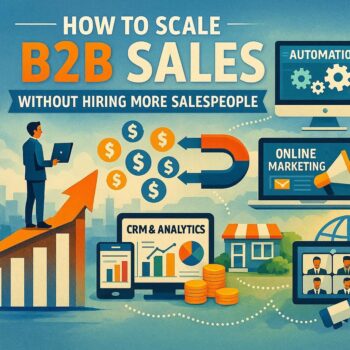
I’ve seen this pattern across dozens of Australian B2B companies in the $2M-$20M range. The sales function looks busy, but it’s not effective. And throwing more people at an ineffective system just gives you an expensive mess.
The companies that break through this ceiling don’t hire their way out. They systematise their way out. They build revenue engines that generate predictable growth without the linear relationship between salespeople and revenue.
This isn’t theory. In my 30+ years working with manufacturers and B2B service companies, I’ve helped businesses unlock 30-40% revenue growth in 90 days without adding a single salesperson. Not through motivation or magic—through systematic redesign of how revenue actually gets generated.
Here’s exactly how to do it.
Why Adding Salespeople Rarely Solves the Problem
Let’s start with the mathematics that every business owner needs to understand.
When you hire a new salesperson in Australia, you’re not just paying their salary. You’re investing $120,000-$180,000 in year one when you factor in base salary, commission structure, superannuation, vehicle allowance, tools, training, and the management time required to get them productive.
For that investment, you need them generating $500,000-$1,000,000 in new revenue just to justify the hire. Depending on your margins, that’s 5-10 new clients or 15-25 project wins in year one.
Now here’s the reality. Most B2B salespeople don’t hit full productivity until month 8-12. In complex manufacturing or technical services, it’s often 12-18 months before they truly understand your products, your customers, and your market well enough to sell effectively.
So you’ve got a 12-18 month payback period on a $150,000 investment, assuming everything goes right.
But everything rarely goes right.
Your new salesperson inherits the same broken systems your existing team is struggling with. They can’t get accurate quotes quickly. They don’t have clear answers about lead times. The CRM is a mess. There’s no documented sales process. Marketing isn’t generating qualified leads. Operations keeps making promises the sales team can’t keep.
Within six months, your expensive new hire is just as frustrated and inefficient as everyone else. They’re spending their time on administrative work, internal coordination, and firefighting—not selling.
Meanwhile, your best salesperson—the one carrying the team—is thinking about leaving because they’re drowning in chaos and watching the new person get resources while the system stays broken.
This is the headcount trap. You hire to solve a capacity problem, but you actually have a systems problem. And systems problems get worse, not better, when you add more people to a broken process.
I watched this play out with a Gold Coast manufacturing client in 2023. They were doing $8M in revenue with three salespeople who were absolutely maxed out. The MD was convinced they needed two more salespeople to hit their $12M target.
We did the analysis. Those three salespeople were spending less than 30% of their time actually selling. The rest was administrative work, fixing quotation errors, chasing internal approvals, and managing customer expectations that operations couldn’t meet.
Instead of hiring, we spent 90 days fixing the system. We automated quote generation. We created a simple capacity planning tool so sales could give accurate lead times. We built a lead scoring system so they stopped chasing dead ends. We documented the sales process so everyone knew what “good” looked like.
Twelve months later, the same three salespeople delivered $11.2M in revenue. A 40% increase. Zero new hires.
That’s the power of systems over headcount.
The Hidden Capacity Already in Your Sales Team
Here’s a confronting question: what are your salespeople actually doing all day?
Most business owners can’t answer this with any precision. They see activity. Meetings. Proposals. Phone calls. But they don’t see where the time actually goes or what percentage of that time is genuinely revenue-generating activity.
When I work with B2B companies, one of the first things I do is a time allocation audit. We track how salespeople spend their time for two weeks across these categories:
- Active selling (prospecting, qualification calls, needs analysis, closing conversations)
- Proposal development (creating quotes, preparing presentations, technical specification work)
- Internal coordination (meetings with operations, chasing approvals, updating systems)
- Customer service (handling existing client requests, relationship maintenance, problem-solving)
- Administration (CRM updates, expense reports, scheduling, email management)
The results are almost always shocking.
In a typical B2B manufacturer or service company, salespeople spend 25-35% of their time on active selling. Sometimes less. The rest is everything else—work that’s necessary but doesn’t require a salesperson’s skills or salary.
Let’s put numbers to this.
If you have three salespeople working 45 hours per week (let’s be honest, that’s the reality), that’s 135 hours per week of sales capacity. If only 30% is actual selling time, you’ve got 40 hours per week of genuine sales activity. The other 95 hours is supporting work.
Now imagine you reclaim just half of that supporting work through better systems. Suddenly you’ve got 87 hours per week of selling time from the same three people. That’s like adding another full-time salesperson without the recruitment, onboarding, or risk.
This is the hidden capacity in your business. It’s not about working harder or longer hours. It’s about eliminating the friction, inefficiency, and waste that’s consuming your sales team’s time.
Here’s where that time typically disappears:
Manual quote generation eats 8-12 hours per week per salesperson in most manufacturing businesses. They’re rebuilding spreadsheets, chasing pricing from purchasing, double-checking margins, and reformatting proposals. Work that could be automated or templated.
Internal coordination consumes another 10-15 hours per week. Sales needs to know when a job can be delivered, but there’s no clear capacity planning. They need technical specifications, but engineering is overwhelmed. They need approval for non-standard terms, but there’s no clear authority matrix.
CRM administration that doesn’t add value takes 3-5 hours per week. Updating fields that nobody uses. Entering data that’s already in emails. Creating reports that no one reads. Compliance for compliance’s sake.
Unqualified leads waste 5-10 hours per week. Marketing sends everything over the fence. Sales chases every enquiry because there’s no filtering system. Half the “opportunities” were never real opportunities in the first place.
Add it up, and you’ve got 25-40 hours per week per salesperson consumed by inefficiency. Multiply that by your team size, and the hidden capacity becomes massive.
The companies that scale without hiring are the ones that systematically reclaim this capacity. They don’t work harder. They work in better systems.
The Five Systems That Multiply Sales Effectiveness
After working with dozens of B2B companies through 90-day revenue acceleration programs, I’ve identified five core systems that consistently unlock hidden capacity and drive growth without adding headcount.
These aren’t theoretical frameworks. They’re practical, implementable systems that transform how revenue gets generated in manufacturing and B2B service businesses.
System 1: The Lead Qualification Framework
Most sales teams waste enormous time on opportunities that were never real opportunities. The enquiry came in, so someone has to follow up. But there’s no systematic way to separate genuine prospects from time-wasters.
A proper lead qualification framework does three things:
First, it defines what “qualified” actually means for your business. Not vague criteria like “good fit” or “seems interested.” Specific, measurable attributes: industry, revenue size, decision-making authority, budget availability, timeline, current pain points, and competitive alternatives.
Second, it creates a scoring system that ranks opportunities objectively. High-value prospects get immediate attention from senior salespeople. Medium-value prospects get nurtured through automated sequences. Low-value prospects get politely redirected or placed in long-term nurture.
Third, it ensures marketing and sales are aligned on these definitions. No more marketing sending everything over the fence. No more sales complaining that leads are “rubbish.” Clear handoff criteria that both teams agree on.
I implemented this with a Brisbane-based industrial services company last year. Their sales team was chasing 120-150 “opportunities” at any given time. Constant activity, minimal conversion.
We built a simple qualification framework based on five criteria: authority (does this person make decisions?), need (do they have a problem we solve?), timeline (when do they need to implement?), budget (can they afford our solution?), and fit (are we technically capable of delivering?).
Anything scoring below 12/20 went into automated nurture. Anything 12-16 got qualified deeper before full pursuit. Only 16+ got immediate, intensive sales attention.
Within 30 days, the active pipeline dropped from 140 opportunities to 45. The sales team panicked initially—until they realised they were spending their time on real opportunities instead of fantasy. Conversion rates doubled. Sales cycle shortened by 35%. Revenue increased 28% in the next quarter with the same team.
That’s what a qualification framework does. It’s not about working harder. It’s about working on the right things.
System 2: The Automated Quote Engine
Quote generation is where enormous sales capacity disappears in most B2B businesses. Every quote is a custom build. Every proposal is recreated from scratch. Every pricing calculation is manual.
Your salespeople are spending 8-12 hours per week building quotes that should take 15 minutes.
An automated quote engine isn’t about buying expensive software. It’s about systematising the logic of how you price, what you include, and how you present it.
Start with quote templates for your 6-8 most common product or service configurations. Not just Word documents—structured templates with pre-approved pricing, standard terms, clear scope definitions, and professional formatting.
Build a simple pricing calculator that handles your margin logic, volume discounts, complexity adjustments, and regional variations. Could be an Excel tool, could be a configuration in your CRM, could be a custom app. The technology doesn’t matter. The logic does.
Create a quote library of standard sections: company introduction, methodology, technical specifications, case studies, terms and conditions, FAQs. Salespeople assemble quotes from pre-written, pre-approved components instead of writing everything fresh each time.
Define approval thresholds clearly. Quotes under $X with margins above Y% can be issued immediately. Quotes outside those parameters need specific approval from specific people. No ambiguity. No delays.
I worked with a Gold Coast fabrication business where quote generation was taking their three salespeople 25-30 hours per week combined. Every quote was a custom spreadsheet. Every proposal was rebuilt in Word. Errors were common. Approvals took days.
We built them a quote engine over six weeks. Configured their product families with standard pricing logic. Created modular quote sections they could assemble quickly. Defined clear approval rules.
Quote generation time dropped from 8-10 hours per week per person to 2-3 hours. That’s 18 hours per week of reclaimed selling time across the team. Quote quality improved. Errors decreased. Approval cycles shortened from days to hours.
The ROI was massive. For about 60 hours of development work, they unlocked 900+ hours per year of sales capacity. That’s a half-time salesperson’s worth of capacity from a six-week systems project.
System 3: The Capacity Visibility Tool
Sales teams can’t sell effectively when they don’t know what operations can actually deliver. Every deal becomes a negotiation. Every customer conversation includes vague promises. Every closed deal creates tension between sales and operations.
The solution isn’t complex enterprise software. It’s a simple, visual tool that shows your sales team real-time capacity across your key constraints.
For manufacturers, this might be machine hours, labour capacity by skill set, or materials lead times. For service businesses, it’s consultant availability, project bandwidth, or delivery team capacity.
The tool needs to answer three questions instantly:
- Can we take this job?
- When can we realistically deliver?
- What’s the impact on existing commitments?
I built this for a Melbourne engineering firm with a four-person sales team and a 20-person delivery operation. Sales was constantly promising delivery dates that operations couldn’t meet. Operations was constantly pushing back on what sales had sold. Customers were frustrated. Internal relationships were toxic.
We created a simple capacity planning board. Showed current projects by engineering discipline. Showed available hours by week for the next 12 weeks. Showed which projects were at risk if new work came in.
Sales could see in 30 seconds whether a new project was feasible and when delivery was realistic. They stopped making promises they couldn’t keep. Operations stopped getting ambushed by unrealistic commitments. Customer satisfaction improved dramatically because delivery dates were accurate.
The interesting outcome was revenue growth. When sales could give confident, accurate delivery dates, close rates increased. Customers valued certainty over optimistic promises that wouldn’t be met. Revenue grew 22% in six months just from improved credibility.
Capacity visibility isn’t about constraining sales. It’s about giving them the information they need to sell confidently and set proper expectations.
System 4: The Documented Sales Process
Most B2B companies don’t have a sales process. They have whatever each individual salesperson does, based on their experience and instincts.
That works fine when you have one superstar salesperson. It fails completely when you try to scale, when that person leaves, or when you need consistent results across a team.
A documented sales process defines the exact steps from initial contact to closed deal, what happens at each step, who’s responsible, what tools are used, and what “good” looks like.
This isn’t about bureaucracy. It’s about capturing what your best salespeople do instinctively and making it repeatable for everyone.
Here’s what a proper sales process includes:
Defined stages that reflect how your customers actually buy, not how you want to sell. Enquiry, qualification, needs analysis, solution design, proposal, negotiation, close. Or whatever reflects your reality.
Clear entry and exit criteria for each stage. What has to happen before you move an opportunity from qualification to needs analysis? What information must you have? What questions must be answered?
Specific activities at each stage. Not vague descriptions like “build relationship.” Concrete actions: conduct discovery call using standard question set, complete technical assessment form, develop proposal using quote engine template, schedule final review with decision committee.
Tools and templates for each activity. Discovery call script. Technical assessment checklist. Proposal template. ROI calculator. Whatever your people need to execute the process effectively.
Time expectations for how long each stage typically takes and when follow-up should happen. Creates urgency and prevents opportunities from going stale.
I documented this process for a Sydney-based industrial equipment distributor. They had five salespeople with five completely different approaches. The top performer was doing $2.8M per year. The bottom performer was struggling to hit $800K.
We mapped the top performer’s process. How he qualified. What questions he asked. How he structured proposals. When he followed up. What objections he anticipated. How he closed.
Then we documented it as the company’s standard process. Trained everyone on it. Built the supporting tools. Managed adoption.
Eighteen months later, the bottom performer was at $1.6M. The middle performers all exceeded $2M. The top performer hit $3.2M because he was spending less time on low-value activities and more time on high-value opportunities.
Total team revenue increased from $8.2M to $11.8M. Same five people. Better system.
System 5: The Pipeline Intelligence Dashboard
Sales teams can’t improve what they can’t measure. And most CRM reports are useless for actual decision-making.
A pipeline intelligence dashboard shows you the metrics that actually matter for revenue growth: conversion rates by stage, average deal size by product line, sales cycle length by customer type, win rates by competitor, velocity through each stage, and pipeline coverage ratio.
This isn’t about data for data’s sake. It’s about identifying where your sales process is breaking down so you can fix it systematically.
If your conversion rate from proposal to close is 25% but your top performer converts at 45%, that’s a training opportunity. What is she doing differently that others can learn?
If your average sales cycle is 120 days but deals with engineering firms close in 75 days while deals with construction companies take 180 days, that tells you where to focus your prospecting efforts.
If your pipeline coverage ratio (total pipeline value divided by quarterly target) is 2.5X but you’re still missing targets, you’ve got a qualification problem. Your pipeline is full of fantasy opportunities.
I built this dashboard for a Perth mining services company. Their sales reporting was total pipeline value and closed revenue. That’s it. No visibility into conversion, velocity, or where deals were stalling.
We implemented a simple dashboard tracking eight key metrics. Within two months, patterns became obvious. Deals were stalling in the technical review stage because sales wasn’t getting engineering involved early enough. Win rates against one specific competitor were terrible because they weren’t differentiating effectively. Large deals were taking 40% longer than small deals, but nobody had noticed.
We fixed those three issues and revenue increased 18% in the next quarter. Not from working harder. From working smarter based on actual data about what was working and what wasn’t.
The 90-Day Implementation Roadmap
Theory is useless without implementation. Here’s the exact 90-day roadmap I use with clients to transform sales effectiveness without adding headcount.
This isn’t a generic consulting framework. It’s the battle-tested approach that’s delivered results across dozens of Australian B2B companies in the $2M-$20M range.
Month 1: Diagnosis and Foundation (Days 1-30)
Week 1: Current State Assessment
We start by understanding exactly where time and revenue are disappearing. This means:
Time allocation audit with your sales team. Two weeks of detailed tracking to understand how they’re actually spending their time versus how they think they’re spending it.
Revenue analysis by product line, customer segment, and salesperson. Where’s the money actually coming from? What’s profitable? What’s just keeping people busy?
Sales process mapping. We interview each salesperson and map their actual process from first contact to close. Not what’s in the handbook—what actually happens.
System audit. What tools do you have? What’s being used? What’s being ignored? Where are the gaps?
Week 2-3: Opportunity Identification
Based on the assessment, we identify the highest-impact opportunities. Usually these fall into three categories:
Quick wins that can be implemented immediately with minimal investment. Template standardisation, approval process clarification, basic automation.
Medium-term improvements that require some development but deliver significant ROI. Quote engine implementation, capacity visibility tools, pipeline reporting.
Strategic initiatives that address fundamental issues but take longer. Complete sales process redesign, CRM replacement, lead generation system overhaul.
We prioritise based on impact, effort, and interdependencies. The goal is measurable improvement within 90 days, not a three-year transformation roadmap.
Week 4: Foundation Build
We implement the foundational elements that everything else depends on:
Clear qualification criteria that sales and marketing both agree on. Documented, measurable, non-negotiable.
Quote templates for your top 6-8 product or service configurations. Professional, complete, ready to use.
Basic pipeline tracking metrics. The 5-8 KPIs that actually matter for your business.
Sales process documentation that captures current best practice. We’re not redesigning yet—we’re documenting what your best people already do.
Month 2: System Implementation (Days 31-60)
Week 5-6: Build and Deploy Core Systems
This is where we implement the high-impact systems identified in Month 1:
Quote engine implementation. Whether it’s Excel-based, CRM-configured, or custom-built, we get it operational and train the team.
Capacity visibility tool deployment. Simple, visual, accessible. Sales knows what they can promise. Operations knows what’s coming.
Lead qualification workflow. Marketing and sales aligned on handoff criteria, scoring methodology, and nurture processes.
Week 7: Process Standardisation
We take the best practices from your top performers and make them the standard for everyone:
Updated sales process with clear stages, activities, and success criteria at each step.
Supporting tools and templates for each stage. Discovery question sets, technical assessment forms, proposal frameworks.
CRM workflow alignment so the system supports the process instead of fighting it.
Week 8: Training and Adoption
Systems don’t work if people don’t use them. Week 8 is intensive training and adoption:
Hands-on training for each new system. Not PowerPoint presentations—actual practice with real opportunities.
Individual coaching with each salesperson on how these systems apply to their current deals.
Daily check-ins to address questions, problems, and resistance.
Month 3: Optimisation and Scale (Days 61-90)
Week 9-10: Monitoring and Adjustment
We watch the systems in action and refine based on reality:
Daily review of key metrics. Are conversion rates improving? Is sales cycle shortening? Is time allocation shifting toward revenue-generating activity?
Weekly team review of what’s working and what isn’t. The people using the systems every day know where the friction is.
Rapid iteration on tools and processes. If the quote engine is missing a common configuration, we add it. If the qualification framework isn’t capturing something important, we adjust it.
Week 11: Results Validation
We quantify the impact and validate that we’re seeing real improvement:
Revenue trending compared to previous quarters. Are we ahead of forecast? By how much?
Capacity analysis. How much selling time have we reclaimed? Where did it come from?
Efficiency metrics. Quote turnaround time, approval cycle length, proposal win rate, sales cycle duration.
Week 12: Sustainment Planning
The final week is about ensuring improvements stick after the intensive implementation period:
Process ownership assignment. Who maintains the quote engine? Who updates the qualification criteria? Who monitors the metrics?
Continuous improvement cadence. Monthly reviews of what’s working, what’s not, and what needs adjustment.
Next phase planning. What’s the logical next system to implement? What additional capacity can we unlock?
By day 90, you should see measurable improvement in at least three areas: reclaimed sales capacity, shortened sales cycles, or improved conversion rates. Usually all three.
And you haven’t hired a single additional salesperson.
The Real ROI of Systems Over Headcount
Let’s talk about money. Because that’s ultimately what matters.
Hiring a new salesperson in Australia costs $120,000-$180,000 in year one when you factor in salary, commission, superannuation, vehicle, tools, training, and management time.
The payback period is 12-18 months, assuming they hit targets and don’t leave.
Systems investment works completely differently.
A 90-day revenue acceleration program typically costs $35,000-$55,000 depending on business complexity. That includes strategy, implementation, training, and initial optimisation.
But the ROI is immediate and compounding.
When you reclaim 20 hours per week of sales capacity across a three-person team, that’s 60 hours per week or 3,000 hours per year. At an effective rate of $150/hour (conservative for B2B sales), that’s $450,000 in reclaimed value.
When you improve your conversion rate from 22% to 32% through better qualification and process, you’re generating an additional $800,000-$1,200,000 in revenue from the same pipeline volume.
When you shorten your sales cycle from 120 days to 85 days, you’re turning inventory faster, improving cash flow, and creating capacity for additional deals.
I’ll give you a real example.
Gold Coast manufacturing client. $9.2M revenue. Three salespeople maxed out. Convinced they needed two more people to hit $13M target.
90-day engagement cost $42,000. We implemented:
- Lead qualification framework (reduced active pipeline from 160 to 55 high-quality opportunities)
- Automated quote engine (reduced quote generation time from 9 hours to 2 hours per week per person)
- Capacity visibility tool (sales could give accurate delivery dates for the first time)
- Standardised sales process (captured what the top performer did instinctively)
- Pipeline intelligence dashboard (identified where deals were stalling)
Results after 12 months:
- Revenue: $12.8M (39% growth)
- Same three salespeople
- Average deal size increased 18% due to better qualification
- Sales cycle shortened from 115 days to 78 days
- Win rate improved from 24% to 37%
- Customer satisfaction scores increased 28 points
Total investment: $42,000. Revenue impact: $3.6M. And it’s sustainable because the systems remain in place.
Compare that to hiring two salespeople:
- Year one cost: $300,000-$350,000
- Productivity ramp: 12-18 months
- Risk: they inherit the same broken systems
- Result: marginal improvement, ongoing overhead
Systems scale. Headcount doesn’t.
When You Actually Should Hire Salespeople
I’m not anti-hiring. I’m anti-hiring as a substitute for fixing broken systems.
There are absolutely times when adding sales headcount is the right move. You just need to get the sequence right.
Hire salespeople when:
Your existing team is operating at peak efficiency and you still have more qualified demand than capacity to handle. If you’re turning away good opportunities because everyone’s calendar is full of genuine selling activity, add headcount.
You’re entering a new market or territory that requires dedicated coverage. If you’re expanding from Queensland to Victoria and your existing team can’t effectively cover both, hire for the new geography.
You’re launching a new product line that requires different expertise. If you’re moving from capital equipment into consumables and the selling motion is completely different, bring in someone with that background.
Your business has scaled to the point where you need specialist roles. A BDR to focus exclusively on prospecting. A sales engineer to handle technical validation. An account manager to nurture key relationships.
But in every case, you need the systems first.
Your new salesperson needs a clear qualification framework so they’re not wasting time on garbage leads. They need a quote engine so they can respond quickly and professionally. They need capacity visibility so they know what they can promise. They need a documented process so they’re not inventing their approach from scratch.
Without systems, you’re just adding another person to a broken machine.
The sequence matters. Fix the systems, unlock the hidden capacity, prove the improvement, then scale with headcount when systems can support it.
Your Next Steps
If you’re running a B2B manufacturer or service company in the $2M-$20M range and you’re hitting a revenue ceiling, you’ve got a choice.
You can keep doing what you’re doing. Keep adding salespeople and hoping that more bodies equals more revenue. Keep fighting the same capacity constraints. Keep watching your team spend 70% of their time on non-selling activities.
Or you can fix the system.
Here’s what I recommend:
Step 1: Run the time allocation audit. Track how your sales team actually spends their time for two weeks. Be honest about what percentage is genuine revenue-generating activity. The results will be uncomfortable, but you can’t fix what you don’t measure.
Step 2: Calculate your hidden capacity. If you reclaimed half the time currently spent on administrative work, quote generation, and internal coordination, how many hours of selling time would that unlock? What’s that worth in revenue?
Step 3: Identify your highest-impact opportunity. Is it quote generation? Lead qualification? Capacity visibility? Sales process standardisation? Pick the one system that would unlock the most capacity fastest.
Step 4: Implement systematically. Don’t try to fix everything at once. Choose one system, implement it properly, train the team, validate the improvement, then move to the next one.
If you want help with any of this, that’s what FBS Consulting does. I work with Australian B2B companies to unlock hidden revenue capacity through systematic operational improvement. Not generic consulting advice—embedded implementation that delivers measurable results in 90 days.
The 90-Day Revenue Acceleration program is specifically designed for businesses in your situation. We diagnose where capacity is disappearing, implement high-impact systems, train your team, and validate improvement.
That’s how you build a revenue engine instead of a revenue treadmill.
Book a 30-minute discovery call to discuss your specific situation and whether systems improvement or headcount addition is the right move for your business: https://calendly.com/fbsconsulting-info/30min
You don’t scale B2B sales by hiring your way out. You scale by systematising your way out. Fix the system, unlock the capacity, then grow without the linear relationship between people and revenue.
FBS Consulting helps Australian manufacturers and B2B companies unlock hidden capacity through systematic operational improvement, delivering measurable results in 90 days without the cost and risk of unnecessary capital expansion.
Book a free 30-minute consultation to discuss how we can help.
About Drew Robins
Drew brings 30+ years of international revenue leadership experience, having scaled businesses from startup to £8M+ across Australian and UK markets. As founder of FBS Consulting, he helps manufacturers and B2B companies build systematic revenue operations that enable sustainable growth without founder dependency. Recent client results include $3.4M pipeline generation in 4 months and business valuations increased by $1.6M+ through operational systematisation.
📩 https://calendly.com/fbsconsulting-info/30min
Also, if you enjoyed this blog find more at our Resources Page.