
Why Your SOPs Don't Work
Why Your SOPs Don't Work
Monday 29th December
The Documentation Trap: Why Your SOPs Don’t Work (And How to Fix Them)
Why most procedure documentation becomes expensive shelf-ware, and the systematic approach that actually builds operational capability
The operations manager opens the shared drive folder labelled “Standard Operating Procedures”. Fifty-three documents. Last updated: 18 months ago. She closes it and walks over to ask Mike how to handle the situation. Again.
Sound familiar?
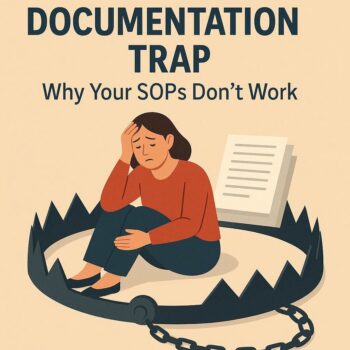
You’ve invested time creating documentation. Management consultants told you to “document your processes”. Business advisors insisted “you need SOPs to scale”. So you did it. Spent weeks writing procedures. Created detailed step-by-step guides. Organised them neatly in folders.
Then nothing changed.
Staff still ask the same questions. New employees still take months to reach productivity. Critical knowledge still lives in Mike’s head. And when Mike eventually leaves, that expertise walks out the door with him.
Here’s the uncomfortable truth: most Standard Operating Procedures are expensive shelf-ware that nobody actually uses.
After 30 years helping Australian manufacturers and B2B companies build systematic operations, I’ve seen this pattern repeatedly. Businesses invest thousands of hours creating documentation that gathers digital dust whilst their actual operations remain dependent on tribal knowledge and individual heroics.
Let me show you why this happens, what it’s actually costing you, and the systematic approach that transforms documentation from ignored paperwork into genuine operational capability.
The Real Cost of Documentation That Doesn’t Work
Before we explore why SOPs fail, let’s quantify what ineffective documentation actually costs your business.
For a typical $5M Australian manufacturer or B2B company:
Training Inefficiency:
- New employees take 12-16 weeks to reach basic competency (vs 3-4 weeks with effective SOPs)
- Training consistency varies wildly depending on who’s available to teach
- Experienced staff spend 20-30% of their time answering repeated questions
- Cost per hire: $20,000+ in lost productivity during extended learning curve
- Annual cost (3-4 hires): $60,000-$80,000
Knowledge Risk:
- Critical expertise exists only in key employees’ heads
- When those people leave, their knowledge disappears
- Replacement staff take even longer to learn undocumented processes
- Business continuity depends on specific individuals remaining employed
- Cost per critical departure: $50,000-$125,000 in disruption and lost efficiency
Quality Inconsistency:
- Different team members handle situations differently
- Standards exist “in people’s heads” rather than documented frameworks
- Rework consumes 8-12% of production capacity
- Customer experience varies depending on who’s handling their work
- Annual cost: $45,000-$95,000 in rework, waste, and customer dissatisfaction
Founder Dependency:
- You’re answering the same questions repeatedly because documentation doesn’t provide answers
- Team members escalate routine decisions unnecessarily
- 15-20 hours weekly consumed by questions SOPs should handle
- Strategic work postponed whilst you’re trapped in operational firefighting
- Annual opportunity cost: $120,000-$280,000
Conservative total annual cost of ineffective documentation: $275,000-$580,000
And this assumes you’ve at least attempted to create SOPs. If everything lives in people’s heads with zero documentation, the costs are even higher.
Why Most SOPs Fail: The Seven Deadly Documentation Sins
After assessing dozens of Australian businesses, I’ve identified seven patterns that cause documentation to fail. Your SOPs probably suffer from at least three of these.
Sin #1: Written for Compliance, Not Capability
The Problem:
Most SOPs are created because “we’re supposed to have them”, not because they genuinely enable better operations. They’re written to satisfy:
- ISO certification requirements
- Investor due diligence expectations
- Franchise system obligations
- “Best practice” advice from consultants
The result? Documentation designed to look impressive in folders rather than be useful on the production floor.
What this looks like:
A Queensland manufacturer showed me their “comprehensive SOP library”. Beautifully formatted. Professionally designed templates. Detailed process maps.
Then I watched their production team work. Not one person referenced the SOPs. Why? Because the documents were written in formal corporate language that didn’t match how anyone actually talked or worked.
Sample from their welding procedure SOP:
“Personnel shall ensure appropriate personal protective equipment conformance prior to initiating welding operations. Verification of material specifications against engineering documentation must be completed before commencement.”
What their experienced welder actually needed:
“Before you start: Check you’ve got the right steel (compare part number to the job sheet). Safety gear on (welding helmet, gloves, leather apron). Ready? Here’s the sequence…”
The Real-World Impact:
When SOPs are written for compliance rather than capability, staff ignore them because:
- Language is too formal or technical
- Level of detail is wrong (either too vague or absurdly granular)
- Documents don’t answer the actual questions people have
- No context about why procedures exist (just what to do)
Result: everyone develops their own workarounds, and the “official” procedures become irrelevant.
Sin #2: Created in Isolation Without User Input
The Problem:
Someone in management decides “we need SOPs”. They assign a project manager or bring in a consultant. That person interviews a few people, writes up procedures, and declares victory.
But the people who actually do the work weren’t meaningfully involved in creating the documentation. So, the SOPs don’t reflect operational reality, they reflect what someone external to the process thinks should happen.
Real Example:
A Brisbane distributor hired a consultant to document their order fulfilment process. The consultant spent three days observing, then produced detailed SOPs.
Problems emerged immediately:
- The documented process assumed orders arrived with complete information (they rarely did)
- Steps were sequenced based on “logical flow” rather than operational efficiency
- Critical decision points were missing (what to do when stock is backordered?)
- Workarounds that existed for good reasons were eliminated as “non-standard”
The warehouse team tried following the new SOPs for two days, then reverted to their established methods. When questioned, the warehouse supervisor said: “The procedures don’t work in real situations. They were written by someone who’s never actually picked an order.”
Why This Matters:
The people doing the work understand nuances that external observers miss:
- Why certain steps exist (solving problems that aren’t obvious)
- What varies between different situations
- Where judgment calls are required
- What information is actually needed at each stage
When you exclude operators from creating SOPs, you get theoretically perfect procedures that fail in practice.
Sin #3: No Visual Aids or Job Aids
The Problem:
Most SOPs are walls of text. Paragraph after paragraph of instructions. Maybe some bullet points if you’re lucky. Rarely any diagrams, photos, or visual references.
But humans process visual information 60,000 times faster than text. When you’re trying to complete a procedure while referencing documentation, you need quick visual confirmation, not lengthy reading.
What Effective Documentation Includes:
Photos or diagrams showing:
- What the finished product should look like
- Correct tool positioning
- Quality standards (good vs defect examples)
- Safety equipment requirements
- Material identification
Flowcharts showing:
- Decision points and branching logic
- What to do when exceptions occur
- Escalation paths for problems
Quick reference cards showing:
- Critical specifications at a glance
- Most common scenarios and responses
- Troubleshooting guides
Example Transformation:
A Gold Coast manufacturer had a 12-page text document describing quality inspection procedures. Average inspection time: 8 minutes per unit.
We replaced it with:
- One-page laminated reference card
- Photos showing acceptable vs defect examples
- Simple flowchart for borderline cases
- Quick escalation guide
New inspection time: 3 minutes per unit. Quality catch rate: improved 23%. Why? Because visual references were faster to consult and easier to interpret correctly.
Sin #4: Documentation Doesn’t Reflect Actual Workflows
The Problem:
SOPs often describe idealised processes that don’t match operational reality. They document how things “should” work in perfect conditions, ignoring the exceptions, variations, and practical constraints that define actual operations.
Common Disconnects:
The SOP says: “Verify material certifications before processing.”
Reality: Certifications often arrive after materials (supplier timing issues).
What people actually do: Process materials based on supplier history and verify certifications when they arrive.
Result: Everyone ignores the SOP because following it literally would halt operations.
The SOP says: “Complete quality inspection at each stage.”
Reality: Some stages have built-in quality indicators that make formal inspection redundant.
What people actually do: Skip redundant inspections, focus on critical checkpoints.
Result: SOP creates unnecessary work that experienced staff bypass.
Why This Happens:
When you document an idealised process without accounting for real constraints:
- Material availability variations
- Equipment capacity limitations
- Staff capability differences
- Customer urgency requirements
- Supplier timing uncertainties
You create procedures that look good on paper but can’t be followed in practice.
The Fix:
Document the actual workflow including how exceptions are handled. Not “here’s the perfect process”, but “here’s the standard approach and here’s what to do when these common variations occur”.
Sin #5: No Ownership or Accountability for Keeping SOPs Current
The Problem:
SOPs are created. Filed away. Then never updated. Within months, they’re outdated. Within a year, they’re dangerously misleading.
I assessed a manufacturer whose SOP library referenced:
- Equipment they’d sold 18 months ago
- Software they’d replaced two years ago
- A supplier that had gone out of business
- Quality standards that had been superseded
- Staff positions that no longer existed
When I asked who was responsible for keeping procedures current, the answer was “we all are, I guess”. Which meant nobody was.
Why This Matters:
Operations evolve constantly:
- Better methods are discovered
- Equipment is upgraded or replaced
- Suppliers change
- Customer requirements shift
- Regulations are updated
- Quality standards improve
Without systematic ownership and review processes, your documentation becomes historical fiction rather than operational guidance.
The Accountability Gap:
Most businesses have no clear answer to these questions:
- Who owns each SOP?
- How often are procedures reviewed?
- What triggers an update?
- Who approves changes?
- How are updates communicated to teams?
Result: SOPs decay into irrelevance whilst actual operations continue evolving.
Sin #6: Training Treats SOPs as Reference Material, Not Learning Tools
The Problem:
Most businesses approach training like this:
“Here are the SOPs. Read them. Ask questions if you have any. Now go do the work.”
This completely misses how adults actually learn operational skills. Reading a procedure document doesn’t create capability any more than reading a recipe makes you a chef.
What Effective Training Looks Like:
Progressive Skill Development:
- Start with overview (why this process exists, how it fits into broader operations)
- Demonstrate the procedure (experienced person shows, explains decision points)
- Guided practice (new person performs with coaching and correction)
- Independent practice (new person performs while experienced observer watches)
- Competency confirmation (ability to perform correctly without supervision)
Only then are SOPs useful as reference material for edge cases or forgotten details.
Real Example:
A Brisbane professional services firm had comprehensive process documentation for client onboarding. New staff would spend three days reading procedures, then start handling clients.
Results were poor:
- Mistakes were frequent
- Clients complained about inconsistent experience
- New staff felt overwhelmed and unsupported
- Training time to competency: 12-14 weeks
We redesigned their approach:
Week 1: Shadow experienced staff, observe 10+ client interactions
Week 2: Handle clients with experienced staff present for support
Week 3: Independent handling with review and feedback
Week 4: Full competency, SOPs used as reference for unusual situations
Training time to competency: 4 weeks. Consistency: dramatically improved. New staff confidence: higher from day one.
The Insight:
SOPs should support training, not replace it. They’re reference tools for competent practitioners, not substitutes for proper skill development.
Sin #7: No Feedback Loop for Continuous Improvement
The Problem:
Most SOP systems are one-way: management writes procedures, staff follows them. There’s no systematic way for frontline operators to say “this procedure has a problem” or “I’ve discovered a better approach”.
What This Costs You:
Your frontline team discovers improvements constantly:
- Faster methods
- Safer approaches
- Quality shortcuts that actually work
- Better sequences
- Clever workarounds for common problems
But if there’s no formal process to capture and validate these improvements, they remain individual knowledge rather than becoming organisational capability.
Example:
A Queensland manufacturer had an experienced production operator who’d developed a modification to their standard welding sequence. His approach was 15% faster with better quality outcomes.
But because there was no formal improvement process:
- He never documented it
- Other welders didn’t learn it
- When he retired, the improvement disappeared
- New welders were trained on the slower, less effective method
The Systematic Solution:
Effective SOP systems include:
- Regular improvement suggestion review (monthly or quarterly)
- Testing process for proposed changes
- Clear approval workflow
- Communication system when procedures update
- Recognition for improvements that get adopted
This transforms SOPs from static documents into living systems that continuously improve.
What Effective Documentation Actually Looks Like
After watching hundreds of SOP systems fail and dozens succeed, I’ve identified what separates shelf-ware from genuinely useful documentation.
Characteristic #1: Written in Operational Language, Not Corporate-Speak
Effective SOPs sound like experienced team members explaining procedures to colleagues, not like legal documents or academic papers.
Instead of: “Personnel shall execute verification protocols to ensure conformance with specified tolerances prior to downstream processing operations.”
Write: “Before moving to the next stage: Check these three measurements are within spec (see tolerance chart on wall). If anything’s outside tolerance, tag it and call your supervisor.”
The Test:
Read your SOP aloud. Does it sound like how people actually talk? Would you explain it this way to a new team member over coffee? If not, rewrite it.
Characteristic #2: Structured for Quick Reference, Not Sequential Reading
Effective SOPs are designed for people who need specific information quickly, not readers working through from beginning to end.
Useful Structure:
Quick Overview Section:
- What this procedure accomplishes
- When to use it
- Who’s responsible
- Key safety or quality considerations
- Estimated time
Step-by-Step Instructions:
- Numbered steps in logical sequence
- Decision points clearly marked
- Exception handling integrated
- Visual aids at relevant steps
Reference Information:
- Specifications and tolerances
- Tool and material requirements
- Quality standards
- Troubleshooting guide
- Who to contact for help
Example:
Instead of a 12-page document that must be read sequentially, create a one-page quick reference with:
- Core procedure (80% of situations)
- “What if?” section for common variations
- Reference data in tables or charts
- Photos showing quality standards
Characteristic #3: Exception Handling Built In, Not Ignored
Effective SOPs acknowledge that perfect conditions rarely exist and provide clear guidance for common variations.
Instead of documenting only the ideal scenario:
“Receive material → Verify certification → Process material → Inspect output”
Document the real workflow:
“Receive material → Verify certification*
If certification is with shipment: Proceed to processing
If certification delayed: Check supplier history. If approved supplier with clean record, process and verify cert when arrives. If new supplier or quality concerns, hold and escalate to supervisor.
Process material → Inspect output
If passes inspection: Continue to next stage
If borderline: Reference quality photos, apply judgment based on severity
If clear defect: Tag, isolate, and notify supervisor”*
This approach reflects reality rather than pretending exceptions don’t exist.
Characteristic #4: Integrated with Actual Work, Not Separate Reference Material
Effective documentation is where people need it, when they need it, in the format that’s most useful.
Physical Integration Examples:
Laminated quick reference cards:
- At each workstation
- Showing that station’s specific procedures
- Updated immediately when processes change
- Weatherproof and durable
Visual work instructions:
- Posted at eye level where work is performed
- Photos showing correct setup
- Quality examples visible
- Safety reminders integrated
Digital Integration Examples:
Tablet-based procedures:
- Step-by-step with photos/videos
- Checkboxes to confirm completion
- Links to related procedures
- Easy to update centrally
QR codes:
- On equipment linking to operating procedures
- On materials linking to handling requirements
- On workstations linking to relevant SOPs
- Scannable with any smartphone
Why This Matters:
If accessing your SOP requires leaving the work area, logging into a system, navigating folder structures, and scrolling through documents, people won’t use it.
Make documentation as frictionless as possible to access and use.
Characteristic #5: Living Documents with Clear Ownership and Review Cycles
Effective SOPs have systematic processes for staying current and continuously improving.
Clear Ownership:
Every procedure has:
- Process owner: Person accountable for that procedure’s accuracy and effectiveness
- Subject matter experts: Frontline staff who actually perform the work
- Approver: Manager who validates changes
Regular Review Schedule:
Critical procedures: Quarterly review
Standard procedures: Semi-annual review
Low-frequency procedures: Annual review
Triggered reviews: When equipment changes, regulations update, or quality issues emerge
Improvement Process:
Anyone can suggest improvements:
- Simple suggestion form or digital tool
- Process owner reviews within one week
- Testing conducted if change seems promising
- Implementation if testing validates improvement
- Communication to all affected staff
- Recognition for valuable contributions
Version Control:
- Clear version numbers and dates
- “What changed” summary for each update
- Old versions archived but accessible
- Communication when procedures update
Example System:
A Gold Coast manufacturer implemented this approach:
Monthly SOP review meetings (45 minutes):
- Process owners present any proposed changes
- Team discusses implementation challenges
- Decisions made about testing or adoption
- Communication plan for approved updates
Result: Their SOP library went from static (18 months between updates) to dynamic (average 8-12 improvements implemented monthly). More importantly, staff engagement increased because they saw their suggestions valued and implemented.
The Systematic Approach: Building Documentation That Actually Works
Creating effective SOPs isn’t a documentation project. It’s an operational capability project where documentation is one component.
Here’s the systematic 90-day approach that transforms documentation from shelf-ware into genuine capability.
Phase 1: Discovery and Prioritisation (Days 1-30)
Week 1-2: Identify Critical Processes and Knowledge Gaps
Don’t try to document everything. Start with what matters most:
Critical processes to document first:
- Processes where quality variation has the biggest impact
- Procedures where staff turnover creates serious disruption
- Operations where safety is paramount
- Workflows where new employees struggle most
- Activities where knowledge lives in one or two people’s heads
Assessment approach:
Interview key stakeholders:
- Which processes cause the most problems when not done correctly?
- Where do new employees need the most support?
- What knowledge would be catastrophic to lose if someone left?
- Which procedures are most inconsistent across team members?
Observe actual operations:
- Watch how work is really performed (not how people say it’s done)
- Identify where documentation would genuinely help vs create bureaucracy
- Note where visual aids would add more value than text
- Spot procedures that are actuallyworkarounds for deeper system problems
Review existing documentation:
- What SOPs exist but aren’t used? Why?
- What documentation is actually referenced regularly? What makes it useful?
- Where are gaps between documented procedures and actual practice?
Week 3-4: Create Documentation Roadmap and Quick Wins
Based on discovery, develop:
Prioritised documentation plan:
- Phase 1 (Days 31-60): Top 5-8 critical procedures
- Phase 2 (Days 61-90): Next 8-12 important procedures
- Phase 3 (Months 4-6): Remaining standard procedures
- Ongoing: Continuous improvement process
Quick wins to build momentum:
Identify 2-3 procedures where simple improvements would have immediate impact:
- Safety procedure that needs better visual aids
- Quality standard that’s frequently misunderstood
- Common task where staff constantly ask the same questions
Implementation:
- Create improved version in one week
- Test with frontline team
- Refine based on feedback
- Deploy and measure impact
Purpose: Demonstrate that “this time is different”. Show the team that new documentation will actually help them, not just create more paperwork.
Phase 2: Collaborative Documentation Development (Days 31-60)
The Critical Principle:
Never write SOPs in isolation. Always develop them collaboratively with the people who do the work.
Week 5-6: Process Mapping with Frontline Teams
For each priority procedure:
Step 1: Assemble the right team (4-6 people):
- Process owner (accountable for procedure)
- Experienced practitioners (people who do it daily)
- Quality or safety representative (if relevant)
- Manager (for approval and resource decisions)
- New-ish employee (brings fresh eyes, asks obvious questions)
Step 2: Map the actual process (2-3 hour workshop):
- Start to finish, what actually happens?
- Not what should happen in theory, what happens in practice?
- What decisions get made at each stage?
- What information is needed when?
- What tools, materials, equipment are required?
- What can go wrong and how is it handled?
Step 3: Identify improvement opportunities:
- Steps that could be eliminated
- Better sequences
- Clearer decision criteria
- Enhanced safety or quality checks
Step 4: Document the agreed approach:
- Team validates that documented process reflects reality
- Visual aids identified (photos, diagrams, flowcharts needed)
- Exception handling scenarios included
- Quality and safety standards integrated
Why This Works:
When frontline teams co-create documentation:
- Procedures reflect operational reality
- Staff buy-in is immediate (they designed it)
- Knowledge transfer happens during the process
- Improvements are identified and implemented simultaneously
Week 7-8: Create Usable Documentation Format
Take the mapped processes and transform them into documentation people will actually use.
For each procedure, develop:
Quick Reference Version:
- One-page laminated card or wall poster
- Core procedure with common variations
- Photos showing quality standards
- Decision tree for common exceptions
- Contact information for escalation
Detailed Reference Version:
- Comprehensive procedure in consistent template
- Full context and background information
- Complete exception handling guide
- Troubleshooting section
- Related procedures linked
Visual Aids:
- Photos of correct execution
- Before/after quality examples
- Equipment setup diagrams
- Safety equipment requirements
- Measurement or specification charts
Digital Tools (if applicable):
- Video demonstrations of complex procedures
- Interactive checklists
- Mobile-accessible procedures
- Real-time updates when changes occur
Formatting Standards:
Consistency across all documentation:
- Same template structure
- Common terminology
- Uniform safety callouts
- Consistent visual language
- Clear version control
Testing Phase:
Before finalising any SOP:
Draft review with process team:
- Does this accurately reflect what we agreed?
- Are the visuals helpful?
- Is anything unclear or ambiguous?
- Would this actually help someone new?
Pilot with new or less experienced staff:
- Can they successfully complete the procedure using only the documentation?
- What questions do they still have?
- What’s confusing or missing?
- How long does it take to reference while working?
Refinement based on feedback:
- Adjust language for clarity
- Add missing information
- Improve visual aids
- Simplify where possible
Only then is the SOP approved and deployed.
Phase 3: Implementation and Systematic Use (Days 61-90)
Week 9-10: Training Integration
Documentation alone doesn’t create capability. Effective training uses SOPs as supporting tools, not replacements for instruction.
Structured Training Approach:
For each critical procedure:
Level 1: Overview and Context (30-60 minutes)
- Why this procedure exists
- How it fits into broader operations
- Quality and safety importance
- Common mistakes and consequences
Level 2: Demonstration (1-2 hours)
- Experienced practitioner demonstrates full procedure
- Explains decision points and judgment calls
- Shows how to use SOP as reference
- Answers questions about variations and exceptions
Level 3: Guided Practice (2-4 hours)
- Trainee performs procedure with experienced coach present
- Coach provides real-time feedback and correction
- SOP referenced for specific details or edge cases
- Mistakes identified and learning reinforced
Level 4: Independent Practice (4-8 hours)
- Trainee performs procedure independently
- Experienced observer monitors without intervening
- Quality checks confirm correct execution
- Feedback session after completion
Level 5: Competency Confirmation
- Trainee demonstrates consistent correct execution
- Quality outcomes meet standards
- Can handle common variations independently
- Knows when to escalate exceptions
- Comfortable using SOP for reference
Documentation of Training:
For each person, for each procedure:
- Training completion date
- Competency assessment result
- Trainer signature
- Refresh training due date (for critical or infrequent procedures)
Week 11-12: Systems for Ongoing Maintenance
Ownership Assignment:
Every documented procedure has:
- Process owner: Name and contact
- Review frequency: Quarterly, semi-annual, or annual
- Next review date: Specific date
- Change request process: How to suggest improvements
Communication System:
When procedures update:
- Email notification to all affected staff
- Quick summary of what changed and why
- Training session if change is significant
- Old version archived with “superseded” marking
- New version distributed immediately
Improvement Suggestion Process:
Anyone can suggest improvements via:
- Simple digital form or suggestion box
- Regular team meetings
- Informal conversation with process owner
Every suggestion receives:
- Acknowledgment within one week
- Review by process owner
- Decision (test, adopt, decline with reasoning)
- Communication back to suggester
- Recognition if implemented
Regular Review Meetings:
Monthly (30-45 minutes):
- Process owners report any proposed changes
- Team discusses implementation feasibility
- Approval or further testing decided
- Communication plan for approved updates
Quarterly (1-2 hours):
- Review upcoming procedure refresh schedule
- Discuss any emerging operational challenges
- Identify new procedures that need creation
- Celebrate improvements implemented
Performance Tracking:
Measure effectiveness through:
- New employee training time (target: reduce 60-70%)
- Quality consistency (target: reduce variation 30-40%)
- Frequency of “how do I?” questions (target: reduce 50%+)
- Staff confidence ratings (target: increase significantly)
- Procedure usage (are people actually referencing SOPs?)
Continuous Improvement Indicators:
Track these metrics monthly:
- Number of improvement suggestions submitted
- Percentage of suggestions implemented
- Time from suggestion to implementation
- Staff satisfaction with documentation usefulness
Real-World Transformation: From Shelf-Ware to Operational Capability
Let me share a complete case study showing this systematic approach in action.
Queensland Industrial Manufacturer: The Documentation Challenge
Initial Situation:
$12M annual revenue, 45 staff across production, warehouse, and office.
The Problem:
- Existing SOP library: 127 documents, most over 18 months old
- Nobody used them (found gathering digital dust on shared drive)
- New employee training: 14-16 weeks to basic competency
- Quality inconsistency: 18% rework rate
- Knowledge risk: critical expertise in heads of 3-4 long-serving staff
- Founder spending 20+ hours weekly answering repeated questions
Previous Attempts:
- Hired consultant two years ago to create comprehensive SOPs
- Consultant spent three months documenting everything
- Results professionally presented, impressively detailed
- Team ignored them completely within two weeks
Why the previous attempt failed:
- Documentation created without frontline input
- Written in formal corporate language nobody actually used
- No visual aids or practical job aids
- Didn’t reflect how work was really performed
- No training integration or ownership assigned
- No process for keeping current
The 90-Day Systematic Transformation:
Phase 1: Discovery and Quick Wins (Days 1-30)
Week 1-2: Assessment
We interviewed:
- Production supervisors and operators
- Warehouse staff
- Quality control team
- Experienced long-serving staff
- Recently hired employees
Key findings:
- 80% of questions new staff asked fell into 8 procedure categories
- Visual quality standards were desperately needed (current “standards” were verbal)
- Safety procedures existed but were text-heavy and rarely consulted
- Workarounds had developed for good reasons but weren’t documented
- Staff wanted better documentation but didn’t trust “another documentation project”
Critical procedures identified:
- Production setup and changeover (biggest quality variation source)
- Quality inspection standards (18% rework rate)
- Material handling and storage (safety concerns)
- Customer order processing (consistency issues)
- Equipment maintenance (breakdown frequency)
- Packaging and shipping (damage complaints)
Quick wins implemented (Week 3-4):
Quality Inspection Visual Standards:
- Created photo-based reference showing acceptable vs defect examples
- One-page laminated cards at each inspection station
- Implemented in three days
- Quality consistency improved 31% in first two weeks
Production Setup Checklist:
- Collaborated with experienced operators to document actual setup sequence
- Created step-by-step visual guide with photos
- Reduced setup errors 64% in first month
Why this worked:
- Quick, visible improvements
- Frontline staff directly involved
- Immediate operational benefits
- Built trust that “this time is different”
Phase 2: Collaborative Development (Days 31-60)
Week 5-6: Process Mapping Workshops
For each of the six critical procedures, we conducted 3-hour collaborative workshops:
Example: Production Setup Workshop
Participants:
- Production supervisor (process owner)
- Three experienced operators
- Quality lead
- Maintenance technician
- Employee hired within last 6 months
Output:
- Complete setup sequence documented
- Decision points clearly identified
- Common problems and solutions mapped
- Equipment photos at critical steps
- Safety requirements integrated
- Quality checkpoints specified
Key insight: Experienced operators knew a 4-step shortcut that reduced setup time 12 minutes while maintaining quality. This had never been documented or taught to new staff. Workshop captured it and made it standard.
Week 7-8: Documentation Creation
For each procedure, we created:
Quick Reference Version:
- Laminated one-page card at workstation
- Core procedure with photos
- Quality standards visually shown
- Common exceptions with solutions
- Contact info for escalation
Comprehensive Reference:
- Detailed procedure in consistent template
- Full context and background
- Complete troubleshooting guide
- Related procedures linked
- Version number and date
Visual Aids:
- Before/after setup photos
- Quality standard comparison images
- Safety equipment requirements
- Measurement tolerances
- Tool and material specifications
Testing and Refinement:
Each SOP was tested by:
- New employees (could they follow it successfully?)
- Experienced staff (is it accurate and complete?)
- Supervisor review (does it meet quality and safety standards?)
Average refinement: 2-3 iterations before final approval.
Phase 3: Implementation and Sustainability (Days 61-90)
Week 9-10: Training Integration
Rather than “here are new SOPs, go read them”, we implemented structured training:
For Production Setup (example):
All production staff received:
- 1-hour overview session (why this procedure, how it improves operations)
- Demonstration by experienced operator using new SOP
- Hands-on practice with coaching
- Independent execution with observation
- Competency confirmation
Documentation:
- Training completion recorded for each person
- Competency assessment result logged
- Refresh training scheduled (6 months for critical procedures)
Week 11-12: Ongoing Systems
Ownership Established:
Each procedure assigned to:
- Process owner (accountable person)
- Review frequency (quarterly for critical, semi-annual for standard)
- Next review date (specific date in calendar)
Improvement Process:
Simple suggestion system:
- Digital form accessible from any device
- Monthly review by process owners
- Decision within two weeks
- Recognition for implemented improvements
Communication System:
When procedures update:
- Email to affected staff with summary of changes
- Quick huddle to explain if significant
- Old version marked “superseded” with date
- New version distributed immediately
Performance Tracking:
We established baseline metrics and monitored progress:
Before Implementation:
- New employee training time: 14-16 weeks
- Rework rate: 18%
- Setup time: Average 47 minutes
- Questions to supervisors: 35-40 daily
- Staff using SOPs: Less than 10%
After 90 Days:
- New employee training time: 5-6 weeks (64% reduction)
- Rework rate: 7% (61% improvement)
- Setup time: Average 32 minutes (32% faster)
- Questions to supervisors: 12-15 daily (65% reduction)
- Staff using SOPs: 78% regularly
Financial Impact:
Investment:
90-day Fractional COO engagement: $48,000
Returns (First Year):
Training efficiency:
- 9 weeks saved per new hire × 6 hires = 54 weeks saved
- At average loaded cost $1,200/week = $64,800 saved
Quality improvement:
- Rework reduction: 11 percentage points
- On $12M revenue with 30% labour component = $3.6M labour
- 11% of $3.6M = $396,000 capacity freed (conservative 30% converted to productive use = $118,800 value)
Reduced supervisory time:
- 25 fewer questions daily × 250 work days = 6,250 questions
- At 8 minutes average per question = 833 hours
- Supervisor time at $80/hour = $66,640 saved
Setup time reduction:
- 15 minutes saved per setup × 8 setups daily × 250 days = 30,000 minutes = 500 hours
- At production rate $120/hour = $60,000 value
Conservative total first-year benefit: $310,240
ROI: 646%
Ongoing benefits continue indefinitely with minimal additional investment.
Beyond the Numbers:
Staff feedback (anonymous survey 90 days post-implementation):
- 86% agreed: “New documentation is actually useful”
- 92% agreed: “I feel more confident in my work”
- 79% agreed: “Training is more effective than before”
- 71% agreed: “I can find answers without asking supervisors”
Leadership perspective:
The operations manager reported: “For two years I’ve been buried in questions. The same questions, over and over. Now my team can find answers themselves. I’m finally doing actual operational leadership instead of being a human help desk.”
The Critical Success Factors:
Why this succeeded when previous attempts failed:
- Frontline collaboration: Staff co-created documentation, ensuring it reflected reality
- Quick wins: Early visible improvements built trust and momentum
- Practical format: Visual aids and accessible language, not corporate bureaucracy
- Training integration: SOPs supported training, didn’t replace it
- Ownership assigned: Clear accountability for keeping procedures current
- Continuous improvement: Simple process for suggesting and implementing improvements
- Measurement: Tracked actual usage and impact, not just “completion”
The Common Objections (And Why They’re Wrong)
After presenting this systematic approach to dozens of Australian businesses, I hear the same objections repeatedly. Let me address them directly.
Objection #1: “We Don’t Have Time to Create Proper Documentation”
The Response:
You’re already spending the time. Just inefficiently.
Current state:
- Answering the same questions repeatedly: 15-20 hours weekly
- Training new employees through shadowing: 14-16 weeks per person
- Dealing with quality issues from inconsistent execution: 8-12% capacity
- Firefighting problems that documented procedures would prevent: 10+ hours weekly
Add it up: You’re spending 40-50 hours weekly (2,000-2,500 hours annually) dealing with problems that proper documentation would eliminate or dramatically reduce.
Creating effective SOPs:
- 90-day systematic approach: ~300 hours total investment
- Ongoing maintenance: 5-10 hours monthly
You don’t have time NOT to create proper documentation.
The question isn’t whether you’ll invest the time. It’s whether you’ll invest it once systematically or continue wasting it forever inefficiently.
Objection #2: “Our Business Is Too Complex for Simple Documentation”
The Response:
Complexity is exactly why you need systematic documentation.
The more complex your operations:
- The more critical knowledge lives in experienced people’s heads
- The longer new employees take to reach competency
- The more variation exists in how different people handle situations
- The higher the risk when key people leave
I’ve documented procedures for:
- Custom precision manufacturing with 200+ specifications
- Multi-stage chemical processes with safety-critical steps
- Complex B2B service delivery with high client customisation
- Regulated industries with strict compliance requirements
The key: Break complexity into manageable components. Document core procedures with clear decision frameworks for handling variations. Use visual aids to simplify what words make complicated.
Your complexity isn’t a reason to avoid documentation. It’s the reason documentation is critical.
Objection #3: “We Tried This Before and It Didn’t Work”
The Response:
Yes, and I explained exactly why it didn’t work in the “Seven Deadly Documentation Sins” section.
Your previous attempt probably:
- Created SOPs in isolation without frontline input
- Wrote documentation for compliance rather than capability
- Produced text-heavy documents without visual aids
- Failed to integrate with actual training
- Assigned no ownership for keeping current
- Had no improvement feedback process
This systematic approach is fundamentally different:
- Co-created with the people who do the work
- Designed for operational use, not impressive-looking folders
- Visual, accessible, and practical
- Integrated with structured training
- Clear ownership and review cycles
- Continuous improvement built in
The fact that previous documentation attempts failed doesn’t mean documentation can’t work. It means you need a better approach.
Objection #4: “This Will Stifle Innovation and Flexibility”
The Response:
The opposite is true. Effective documentation enables innovation because it:
Frees people from reinventing the basics:
- Standard procedures handled systematically
- Mental energy available for genuine problem-solving
- Clear baseline from which improvements are identified
Makes innovation systematic:
- Current best practice documented
- Improvements tested against documented baseline
- Successful innovations captured and shared
- Everyone benefits from individual discoveries
Creates capacity for strategic thinking:
- Frontline staff spend less time asking “how do I?”
- Leadership freed from answering repeated questions
- Time available for genuine innovation projects
Example:
That Queensland manufacturer I mentioned? In the 6 months after implementing systematic documentation, they:
- Reduced production setup time 32% through operator-suggested improvements
- Identified 14 quality improvements (12 implemented)
- Freed operations manager to lead efficiency project that generated $180,000 additional capacity
- Launched new product line (previous bandwidth prevented this)
Documentation didn’t stifle innovation. It enabled it by creating the foundation and freeing capacity.
Objection #5: “We Can’t Afford Professional Support”
The Response:
Let’s look at the actual numbers.
Cost of continuing without effective documentation:
- Training inefficiency: $60,000-$80,000 annually
- Quality inconsistency: $45,000-$95,000 annually
- Knowledge risk: $50,000-$125,000 per critical departure
- Founder time wasted: $120,000-$280,000 annually in opportunity cost
Conservative annual cost: $275,000-$580,000
Professional 90-day transformation:
- Investment: $35,000-$55,000
- Typical first-year returns: 300-500% ROI
- Ongoing benefits: Continue indefinitely with minimal additional investment
You can’t afford NOT to fix this systematically.
The question isn’t whether professional support costs money. It’s whether continuing to lose $275,000-$580,000 annually makes sense when a $45,000 investment fixes it.
The DIY Approach: If You’re Determined to Do This Yourself
I strongly recommend professional support for systematic documentation transformation. But if you’re determined to do this yourself, here’s how to maximise your chances of success.
Critical Success Requirements
If you’re going DIY, you MUST:
- Dedicate Protected Time
- Block 10-15 hours weekly for 12 weeks
- This is sacred time, not “fit it in when convenient”
- Off-site if possible, to avoid operational distractions
- Involve Frontline Staff Meaningfully
- Never document in isolation
- Collaborative workshops with people who do the work
- Validate everything with actual practitioners
- Start Small and Build Momentum
- Begin with 3-5 critical procedures
- Prove the approach works before expanding
- Use early wins to build team buy-in
- Measure Real Usage and Impact
- Track whether people actually reference SOPs
- Measure training time improvements
- Monitor quality consistency changes
- Survey staff about usefulness
- Assign Clear Ownership
- Every procedure has a named owner
- Regular review schedule established
- Improvement process implemented
The 12-Week DIY Roadmap
Weeks 1-2: Discovery
- Interview frontline staff about documentation needs
- Observe actual operations
- Identify 3-5 highest-priority procedures
- Review what currently exists (what’s used, what’s ignored, why)
Weeks 3-4: First Procedure Workshop
- Select highest-priority procedure
- Assemble team (process owner, practitioners, new employee)
- Map actual workflow including exceptions
- Identify improvement opportunities
- Document agreed approach
Weeks 5-6: Create First SOP
- Develop quick reference version (one-page)
- Create comprehensive version
- Add visual aids (photos, diagrams)
- Test with frontline team
- Refine based on feedback
Weeks 7-8: Implement and Learn
- Deploy first completed SOP
- Integrate with training for new procedure users
- Monitor usage and gather feedback
- Make adjustments based on real-world use
- Document lessons for subsequent procedures
Weeks 9-10: Scale to Additional Procedures
- Repeat workshop/creation process for procedures 2-3
- Apply lessons from first procedure
- Build library of consistent documentation
Weeks 11-12: Systems for Sustainability
- Assign ownership for all created procedures
- Establish review schedule
- Create improvement suggestion process
- Plan next phase of documentation development
Critical Warning:
DIY approaches typically achieve 40-60% of the results professional support delivers, and take 2-3x longer. Most stall at the 50-70% completion point when operational urgencies consume the time you’d blocked for documentation.
But if you’re committed and disciplined, following this roadmap can deliver meaningful improvements.
When Professional Support Makes Sense
Consider Fractional COO support for systematic documentation transformation if:
You’re facing these situations:
- Previous documentation attempts failed
- Limited internal capacity for sustained 12-week project
- Need faster results (90 days vs 6-12 months DIY)
- Want proven methodologies vs trial-and-error learning
- Operational chaos is costing $250,000+ annually
- Planning business sale or succession (documented processes increase valuation significantly)
Professional support delivers:
Proven Framework:
- Systematic approach refined across dozens of implementations
- Avoids common pitfalls that derail DIY attempts
- Best practices from multiple industries
Objective Facilitation:
- External facilitator keeps process on track
- Navigates internal politics and resistance
- Maintains focus when operational urgencies arise
Rapid Implementation:
- 90 days to transformation vs 6-12 months DIY
- Dedicated expertise vs fitting it around other responsibilities
- Higher completion rate (85-90% vs 30-40% for DIY)
Knowledge Transfer:
- Your team learns the methodology
- Capability remains after engagement ends
- Sustainable improvements, not dependency
Typical Investment and Returns:
90-day Fractional COO engagement:
- Investment: $35,000-$55,000
- Comprehensive documentation transformation
- Training integration
- Sustainability systems implementation
First-year returns (conservative):
- Training efficiency: $60,000-$80,000 saved
- Quality improvements: $45,000-$95,000 value
- Reduced supervision time: $50,000-$80,000 freed
- Knowledge preservation: $50,000-$125,000 risk eliminated
Total typical first-year benefit: $205,000-$380,000
ROI: 370-790%
Ongoing benefits continue with minimal additional investment.
Your Next Steps: Stop Accepting Documentation Shelf-Ware
You’ve invested time and money creating SOPs that nobody uses. You’re tired of answering the same questions repeatedly. You know your operations depend too heavily on knowledge in people’s heads.
The cost of continuing this way:
- $275,000-$580,000 annually in preventable inefficiency
- Vulnerable to knowledge loss when key people leave
- Extended training times limiting growth capacity
- Quality inconsistency damaging customer relationships
- Your time consumed by questions that proper documentation would eliminate
But it doesn’t have to stay this way.
Effective documentation isn’t about creating impressive-looking folders. It’s about building genuine operational capability through systematic, usable procedures that enable your team to succeed independently.
This Week:
Assess your current documentation reality:
- What SOPs exist? Who actually uses them?
- What questions get asked repeatedly?
- Where does critical knowledge live in people’s heads?
- What would happen if your most knowledgeable person left tomorrow?
Calculate what ineffective documentation is costing you:
- Training time × labour cost × number of hires annually
- Quality rework as percentage of capacity
- Your time answering repeated questions × hourly value
- Risk of knowledge loss when key people leave
If the cost exceeds $250,000 annually, you can’t afford to keep accepting this.
This Month:
Decide your approach:
DIY if:
- You can dedicate protected time (10-15 hours weekly for 12 weeks)
- You have discipline to maintain focus when operational urgencies arise
- You’re willing to accept 40-60% of optimal results
- Timeline pressure is low (6-12 months acceptable)
Professional support if:
- Previous attempts failed
- You need results in 90 days, not 6-12 months
- Want proven methodology vs trial-and-error
- Current cost of ineffective documentation exceeds $250,000 annually
- Planning sale or succession (documented processes increase valuation)
Either way, take action. Every month you delay costs $20,000-$50,000 in preventable inefficiency.
Your Complimentary Documentation Assessment
If you’re recognising your business in these challenges, let’s have a conversation about what effective documentation could deliver for your specific situation.
In your complimentary 30-minute Documentation Assessment, we’ll:
- Identify your top 3-5 documentation gaps that are costing the most
- Calculate your specific annual cost of ineffective documentation
- Assess whether DIY or professional support makes more sense for your situation
- Provide actionable recommendations whether you engage our services or not
No obligation. No pressure. Just clarity about whether your documentation is enabling operations or creating expensive shelf-ware.
Recent assessment outcomes:
- Queensland manufacturer: Avoided 6-month DIY struggle, achieved 64% training time reduction in 90 days
- Brisbane distributor: Freed operations manager from 20 hours weekly of repeated questions
- Gold Coast service business: Improved quality consistency 31% through visual documentation
The question isn’t whether you need better documentation. It’s how much longer you’ll accept losing $250,000-$580,000 annually whilst critical knowledge remains trapped in people’s heads.
The Bottom Line
Your SOPs don’t work because they were created wrong: in isolation, for compliance, without user input, as text-heavy documents, with no training integration, no ownership assigned, and no improvement process.
The solution isn’t more documentation. It’s better documentation.
Effective SOPs are:
- Co-created with frontline staff who do the work
- Written in operational language, not corporate-speak
- Visual and accessible, designed for quick reference
- Integrated with structured training
- Owned by specific people with regular review cycles
- Connected to continuous improvement processes
This transforms documentation from shelf-ware into genuine operational capability.
The systematic 90-day approach delivers:
- Training time reduced 60-70%
- Quality consistency improved 30-40%
- Founder time freed 15-20 hours weekly
- Knowledge preserved systematically
- Team capability that scales with growth
Conservative ROI: 300-500%+ in first year
Your business deserves documentation that actually works. Your team deserves procedures that enable their success. You deserve to stop being a human help desk for questions that proper SOPs should answer.
Stop accepting documentation shelf-ware. Start building operational capability.
“Here’s the uncomfortable truth: most Standard Operating Procedures are expensive shelf-ware that nobody actually uses.
After 30 years helping Australian manufacturers and B2B companies build systematic operations, I’ve seen this pattern repeatedly. Businesses invest thousands of hours creating documentation that gathers digital dust whilst their actual operations remain dependent on tribal knowledge and individual heroics.“
Contact Drew Robins for Your Complimentary Documentation Assessment:
📞 Phone: 0468 794 040
📧 Email: info@fbsconsulting.com.au
🌐 Website: www.fbsconsulting.com.au
FBS Consulting helps Australian manufacturers and B2B companies transform documentation from expensive shelf-ware into genuine operational capability through systematic 90-day implementations that deliver measurable training efficiency, quality improvements, and freed founder capacity.
Book a free 30-minute consultation to discuss how we can help.
About Drew Robins
Drew brings 30+ years of international revenue leadership experience, having scaled businesses from startup to £8M+ across Australian and UK markets. As founder of FBS Consulting, he helps manufacturers and B2B companies build systematic revenue operations that enable sustainable growth without founder dependency. Recent client results include $3.4M pipeline generation in 4 months and business valuations increased by $1.6M+ through operational systematisation.
📩 https://calendly.com/fbsconsulting-info/30min
Also, if you enjoyed this blog find more at our Resources Page.