
Why Your Best Salesperson Makes a Terrible Sales Manager
Why Your Best Salesperson Makes a Terrible Sales Manager
Monday 22nd December
Why Your Best Salesperson Makes a Terrible Sales Manager (And What to Do Instead)
The $300K mistake Australian manufacturers keep making, and the strategic alternative that actually works
The conversation always starts the same way.
“Drew, we need to promote Sarah to sales manager. She’s our top performer, closes 60% of her opportunities, customers love her. She knows the business inside out. It’s the natural progression.”
My response usually stops them cold: “Before you do that, let’s talk about what happened to the last three top performers you promoted into management.”
The silence that follows tells me everything. They know exactly what happened. The top performer struggled in management, team performance declined, and within 18 months they either left the business or returned to selling, leaving a trail of disruption and lost revenue.
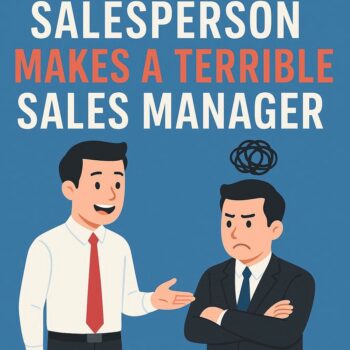
Yet businesses keep making this same expensive mistake. After 30 years working with Australian manufacturers and B2B companies, I’ve watched this pattern destroy more sales teams than any other single decision.
Here’s the uncomfortable truth: your best salesperson will almost certainly make a terrible sales manager. And promoting them isn’t just ineffective, it’s actively destructive to your revenue growth.
Let me show you why this happens, what it actually costs, and what smart businesses do instead.
The Logic That Seems So Obvious (But Isn’t)
The reasoning behind promoting top salespeople into management appears bulletproof:
They’ve Proven They Can Sell:
- Consistently exceeds targets
- Understands products and customers deeply
- Has credibility with the team
- Knows what works in your market
They Deserve Recognition:
- Rewarding top performers with promotion
- Clear career progression pathway
- Retaining your best talent
- Showing the team that performance is rewarded
They Can Teach Others:
- “If everyone sold like Sarah, we’d double revenue”
- They can share their techniques and approaches
- Team will respect someone who’s walked in their shoes
- They understand the challenges salespeople face
This logic is so compelling that businesses fall into this trap repeatedly. But here’s what this reasoning misses: the skills that make someone an exceptional salesperson are fundamentally different from the skills that make someone an effective sales leader.
Why Great Salespeople Fail at Management
The Individual Contributor Mindset vs Strategic Leadership
Top salespeople succeed through personal excellence. They win by being better than their peers at building relationships, handling objections, closing deals. Their success is measurable, immediate, and individual.
Management success requires something completely different:
- Building systems that enable others to succeed
- Developing people rather than outperforming them
- Strategic thinking over tactical execution
- Patience with gradual improvement rather than immediate wins
The Competitive Drive That Becomes Destructive
What makes Sarah your best salesperson? Probably intense competitive drive. She wants to win, personally. She compares herself to her peers and strives to be number one.
Now make her the manager of those peers. That competitive instinct doesn’t disappear; it just becomes problematic:
- She struggles to celebrate others’ success (because it used to be competition)
- She unconsciously undermines team members who might outperform her previous numbers
- She “takes over” deals when team members are struggling (destroying their development)
- She can’t step back and let others learn through mistakes
One Queensland manufacturer promoted their top performer to sales manager. Within three months, he was personally handling 40% of the team’s opportunities. Why? “They weren’t doing it right, and I couldn’t watch us lose deals.”
The team stopped trying. Why compete for opportunities when the boss will take over anyway?
The Tactics vs Strategy Gap
Exceptional salespeople master tactics: how to qualify prospects, run effective demos, handle specific objections, close deals. These are execution skills that work in individual scenarios.
Sales leadership requires strategic thinking:
- Designing systematic lead qualification frameworks (not just “I know a good lead when I see one”)
- Building repeatable sales processes (not just “here’s how I do it”)
- Forecasting based on pipeline data and conversion trends (not gut feel)
- Resource allocation across territories and opportunities
- Go to market strategy and positioning
I recently assessed a Brisbane manufacturer’s sales operation. Their newly promoted sales manager (former top performer) was spending 60% of his time on tactical coaching, “Here’s how I would handle that objection.”
What he wasn’t doing:
- Analysing why conversion rates were declining in specific segments
- Identifying systematic bottlenecks in their sales process
- Developing objective qualification criteria to prevent wasted pursuit
- Building forecasting capability that leadership could trust
The Doing vs Enabling Paradox
This is perhaps the most insidious problem. When a top performer becomes a manager and sees team members struggling, their instinct is to do it themselves rather than enable others to improve.
Why? Because doing it themselves produces immediate results. Teaching someone else is slower, messier, and requires tolerating imperfect execution whilst people learn.
But every time the manager “does it themselves,” they:
- Reinforce team dependency rather than building capability
- Prevent team members from developing through experience
- Create a bottleneck where their personal capacity limits team output
- Train the team that their role is lead generation for the manager
One client’s promoted sales manager was handling every negotiation personally because “the team doesn’t know our pricing flexibility.” Two years later, the team still didn’t know, because he’d never taught them.
The Real Cost of This Mistake
Let’s quantify what promoting your top performer into sales management actually costs.
Direct Revenue Loss from Top Performer
Your top salesperson was generating, let’s say, $1.5M annually (typical for a strong performer in $5M-10M manufacturer). Promote them to management, and that personal production drops to perhaps $400K (because they’re still “helping” close deals).
Lost revenue: $1.1M annually
But you’re gaining a manager, you argue. Surely the team will perform better?
Usually not. Here’s what typically happens.
Team Performance Decline
In the first 6-12 months after promotion, team performance often declines:
- Top performer’s production drops 70-80% ($1.1M loss as calculated)
- Other team members’ performance drops 10-20% (they’re now being “managed” by someone learning on the job)
- For a team of 3 other salespeople generating $800K each: 15% decline = $360K lost
Recruitment and Replacement Costs
You’ve created a gap where your top performer used to be. Now you need to hire a replacement. But new salespeople take time to ramp:
- Recruitment costs: $15,000-25,000
- Training and onboarding: 6-9 months to productivity
- Lost opportunity during ramp period: $500K-700K
The Compounding Effect When It Fails
Here’s where it gets really expensive. In 60-70% of cases, this promotion fails within 18 months. When that happens:
Scenario A: They Leave the Business
- You’ve lost your top performer permanently
- Team has experienced 18 months of poor leadership
- Morale is damaged
- You’re recruiting for both sales manager AND the top performer role
- Total disruption cost: $400K-600K
Scenario B: They Return to Selling
- Damaged confidence and strained relationships
- Team confused about leadership and direction
- 18 months of lost momentum
- Still need to find actual sales leadership
- Total cost: $300K-500K
Conservative total cost of unsuccessful promotion: $2M-2.5M over 24 months for a typical $8M manufacturer.
And this assumes you recognise the problem and address it. Many businesses let this dysfunction persist for years.
The Warning Signs You’re Making This Mistake
How do you know if your promoted top performer is struggling as a manager?
Red Flags in Team Performance:
- Individual team member numbers declining or stagnant
- Pipeline quality deteriorating (more opportunities, fewer conversions)
- Team increasingly reliant on manager to close deals
- High activity metrics but poor results
- Inconsistent forecasting accuracy
Red Flags in Team Dynamics:
- Team members hesitant to make decisions without manager approval
- Declining morale or increased tension
- Top performers on team becoming frustrated or disengaged
- Manager working 60-70 hour weeks whilst team works 40-45
- Team members leaving citing lack of development or autonomy
Red Flags in Manager Behaviour:
- Still personally handling 30%+ of sales opportunities
- Spending most time on tactics rather than strategy
- Unable to articulate systematic approaches to common challenges
- Defensive when questioned about team performance
- Constantly “rescuing” deals team members are working
Strategic Warning Signs:
- Founder still heavily involved in most major deals
- No systematic lead qualification (manager relies on “gut feel”)
- Sales process exists “in manager’s head” not documented
- Forecasting is guesswork rather than data driven
- Win rate hasn’t improved despite having a “manager”
What You Actually Need (It’s Not a Sales Manager)
Here’s the controversial insight: most $5M-15M manufacturers don’t need a sales manager at all. What they need is strategic revenue leadership.
Let me explain the difference.
Sales Manager Role:
- Tactical coaching on individual deals
- Activity monitoring and motivation
- Territory management
- Individual performance management
- Pipeline reporting
This role makes sense when:
- You have 8+ salespeople requiring daily coordination
- Sales process is well established and documented
- Strategy is set, you just need execution management
- Individual contributors need tactical coaching and motivation
Strategic Revenue Leadership (CRO Function):
- Revenue operations design and implementation
- Cross functional alignment (marketing, sales, operations)
- Go to market strategy and positioning
- Systematic lead qualification and prioritisation
- Pipeline management frameworks and forecasting
- Team capability development through systems, not individual coaching
- Unit economics and pricing strategy
This is what most growing manufacturers actually need:
- Clear, repeatable sales processes
- Systematic approach to qualification and prioritisation
- Forecasting you can actually trust
- Marketing and sales alignment
- Team capability that isn’t dependent on one person’s heroics
The difference? Sales management focuses on helping individuals sell better. Revenue leadership builds systems that enable consistent, scalable revenue generation.
The Fractional CRO Alternative
This is where the conversation shifts from “who do we promote?” to “what capability do we actually need?”
For most $5M-15M manufacturers, a Fractional CRO delivers what you’re actually trying to achieve through that promotion:
Strategic Revenue Leadership:
- Executive level expertise in revenue operations
- Systematic approach to sales process design
- Team development through capability building, not individual coaching
- Data driven forecasting and pipeline management
- Marketing and sales alignment
Without the Downsides:
- You don’t destroy your top performer’s revenue contribution
- No learning curve whilst someone “figures out” management
- Proven methodologies from implementing revenue systems across multiple businesses
- Objective perspective without internal politics or career concerns
- Dramatically lower investment than full time executive hire
The Investment Comparison:
Promoted Top Performer Approach:
- Lost top performer revenue: $1.1M annually
- Team performance decline: $360K annually
- Recruitment and ramp costs: $500K-700K
- Total cost: $2M+ over 18 months (if it fails)
- Success rate: 30-40%
Fractional CRO Approach:
- 90 day engagement: $45,000-60,000
- Ongoing support: $8,000-15,000 monthly (if needed)
- Top performer continues selling: $1.5M revenue maintained
- Team performance improvement: typically 20-35% increase
- Total investment: $100K-180K over 18 months
- Success rate: 85-90%
The ROI isn’t even close.
What Fractional CRO Support Actually Delivers
Let me show you what this looks like in practice.
90 Day Revenue Operations Transformation:
Phase 1: Discovery and Quick Wins (Days 1-30)
Rather than promoting someone and hoping they figure it out, a Fractional CRO brings immediate strategic insight:
Week 1-2: Revenue Operations Assessment
- Complete sales process mapping (what actually happens vs what should happen)
- Team capability evaluation (not just “who’s hitting numbers” but why)
- Pipeline analysis and forecasting methodology review
- Marketing to sales handoff assessment
- Customer acquisition cost and lifetime value analysis
Week 3-4: Strategic Framework and Quick Wins
- Systematic lead qualification criteria (moving beyond gut feel)
- Pipeline management framework implementation
- Early improvements to remove obvious bottlenecks
- Team engagement and buy in development
Typical Week 4 Position:
- Clear visibility into actual revenue constraints (often not what you thought)
- 10-15% improvement in pipeline quality from initial changes
- Team confident in new direction
- 60 day roadmap established
Phase 2: System Implementation and Team Development (Days 31-60)
This is where promoting a top performer typically fails, they try to teach “how I do it” rather than building systematic capability.
A Fractional CRO implements:
Repeatable Sales Processes:
- Documented qualification frameworks (not “I know it when I see it”)
- Systematic discovery and needs analysis approaches
- Proposal and pricing guidelines with clear authority levels
- Objection handling playbooks for common scenarios
- Closing techniques appropriate to your market
Team Capability Building:
- Training on new processes and frameworks
- Role playing and practice on real opportunities
- Coaching individuals on applying systems to their situations
- Performance metrics that drive right behaviours
- Regular pipeline reviews using consistent methodology
Revenue Operations:
- Marketing and sales alignment on ideal customer profile
- Clear handoff processes and service level agreements
- Forecasting models based on data, not hope
- Unit economics tracking by segment and product
- Regular revenue reviews with cross functional accountability
Typical Week 8 Position:
- 25-35% improvement in team effectiveness (same people, better systems)
- Consistent, reliable forecasting (finally)
- Your top performer still selling at full capacity
- Clear pipeline visibility and predictable revenue
Phase 3: Optimisation and Sustainability (Days 61-90)
The final phase ensures improvements stick after the intensive engagement ends:
System Refinement:
- Fine tune processes based on real world results
- Address remaining friction points
- Scale successful approaches across entire team
- Build continuous improvement mechanisms
Knowledge Transfer:
- Train internal champion to maintain systems (could be your top performer, now with proper frameworks)
- Comprehensive documentation of processes and frameworks
- Establish performance dashboards for ongoing monitoring
- Create feedback loops for system evolution
Strategic Planning:
- Assess if full time sales leadership now makes sense (with clear job description)
- Develop long term revenue growth roadmap
- Identify next capability development priorities
Typical Week 12 Position:
- 30-40% improvement in team performance sustained
- Self sustaining revenue systems
- Clear understanding of when/if you need full time sales leadership
- Your top performer thriving in selling role with better support systems
Real World Results: The Difference in Action
Case Study 1: The Promoted Top Performer (What NOT to Do)
Brisbane Industrial Supplier – The Traditional Approach
Situation:
- $12M revenue, 4 person sales team
- Top performer (Lisa) generating $3.2M annually
- Promoted Lisa to sales manager after 8 years of strong performance
18 Months Later:
- Lisa’s personal revenue: $3.2M → $800K (75% decline)
- Other team members’ average performance: $2.4M → $2.0M (17% decline)
- Team morale declining (frustration with Lisa’s management style)
- Hired replacement for Lisa’s former territory (still ramping, 6 months in)
- Total team revenue: $12M → $10.8M (10% decline)
Problems Identified:
- Lisa trying to manage by “doing it herself” rather than enabling others
- No systematic sales process (everything was “how Lisa does it”)
- Team becoming dependent rather than capable
- Lisa stressed, working 65 hours weekly
- Forecasting still based on gut feel, not methodology
Total Cost of Promotion Decision:
- Lost revenue: $1.2M over 18 months
- Recruitment and training costs: $45,000
- Lisa’s productivity loss: $2.4M over 18 months
- Opportunity cost: Incalculable
- Total measurable impact: $3.65M+
Case Study 2: The Fractional CRO Alternative (What Actually Works)
Gold Coast Manufacturer – The Strategic Approach
Situation:
- $8M revenue, 3 person sales team
- Top performer (Michael) generating $2.8M annually
- Considering promoting Michael to sales manager
Decision: Engaged Fractional CRO instead, kept Michael in selling role
90 Day Transformation:
Phase 1 (Days 1-30):
- Discovered 45% of opportunities were poorly qualified (wasting pursuit time)
- Marketing was generating “leads” that rarely converted
- No systematic pricing strategy (quotes varied 18% for similar scope)
- Forecasting was guesswork
Quick Wins Implemented:
- Lead qualification criteria (reduced wasted pursuit by 60%)
- Marketing realignment to ideal customer profile
- Pricing guidelines with clear authority levels
- Initial pipeline management framework
Phase 2 (Days 31-60):
- Documented complete sales process
- Implemented systematic discovery and qualification
- Created proposal templates and pricing frameworks
- Established regular pipeline reviews with consistent methodology
- Trained team on new systems and approaches
Phase 3 (Days 61-90):
- Fine tuned processes based on real results
- Built internal capability to maintain systems
- Established performance dashboards and metrics
- Created continuous improvement mechanisms
Results After 90 Days:
- Michael’s revenue: $2.8M → $3.1M (remained top performer with better support)
- Other team members’ average: $1.6M → $2.2M (38% improvement with same people)
- Total pipeline: $3.4M in qualified opportunities (vs $1.8M previously)
- Confirmed orders: $1.0M from new systematic approach
- Forecasting accuracy: 45% → 89%
12 Month Results:
- Total revenue: $8M → $10.7M (34% growth)
- Same team size (no additional hires needed)
- Michael thriving in selling role, not burdened with management
- Team confident and capable with systematic processes
- Predictable revenue operations
Investment Comparison:
Fractional CRO Approach:
- 90 day intensive engagement: $52,000
- Ongoing support (6 months): $48,000
- Total investment: $100,000
Returns:
- Revenue growth: $2.7M ($8M → $10.7M)
- Michael’s continued high performance: $2.8M maintained
- Team capability improvement: $1.8M additional
- ROI: 2,700% in first year
Versus Promoted Top Performer Approach:
- Would have lost $2.1M in Michael’s production ($2.8M → $700K typical decline)
- Likely team decline of 15-20%: $480K-640K
- Total cost: $2.5M-2.7M over 12 months
The difference is stark.
When Promoting Internally DOES Make Sense
To be clear: I’m not saying you should never promote from within. I’m saying most businesses promote the wrong person for the wrong reasons at the wrong time.
Promote Internally When:
- The Person Has Demonstrated Management Capability
Not just sales excellence, but actual management behaviours:
- They’ve successfully mentored and developed other team members
- They think strategically about pipeline and process, not just their personal deals
- They can step back and let others succeed (even if imperfectly)
- They’re more interested in team success than personal wins
- They can articulate systematic approaches to common challenges
- You Have Systems Already in Place
Don’t ask someone to build sales management systems from scratch whilst learning to manage:
- Documented sales processes and qualification frameworks
- Established forecasting methodology
- Clear performance metrics and dashboards
- Marketing to sales handoff procedures
- Regular pipeline review cadence
- The Role is Actually Management, Not Strategy
If you need someone to:
- Coach individuals on executing established processes
- Monitor activity and performance against known metrics
- Coordinate territory and opportunity assignments
- Conduct regular pipeline reviews using existing methodology
That’s management work that a promoted high performer might excel at.
But if you need someone to:
- Design revenue operations from scratch
- Build forecasting systems
- Align marketing and sales strategies
- Develop pricing frameworks
- Create systematic approaches to qualification and closing
That’s strategic work requiring different expertise.
- You’re Prepared to Invest in Their Development
Management isn’t intuitive. If you’re promoting internally, commit to:
- Formal management training (not just “figure it out”)
- Executive coaching (outside perspective on challenges)
- Gradual responsibility transition (not overnight promotion)
- Permission to make mistakes whilst learning (without destroying revenue)
Most businesses skip these investments, hoping natural sales talent transfers to management. It doesn’t.
The Strategic Question Every Business Should Ask
Before you promote your next top performer, ask yourself:
“What problem are we actually trying to solve?”
If the answer is:
- “We need better sales forecasting”
- “Marketing and sales aren’t aligned”
- “Our sales process is inconsistent”
- “We need systematic qualification and prioritisation”
- “We want predictable revenue operations”
You don’t need a sales manager. You need strategic revenue leadership.
And for most $5M-15M manufacturers, Fractional CRO support delivers that capability:
- Executive level expertise without executive level cost
- Proven systems and methodologies, not learning on the job
- Objective strategic perspective without internal politics
- Preserves your top performer’s revenue contribution
- Dramatically higher success rate
The question isn’t whether you can afford Fractional CRO support. It’s whether you can afford another $2M mistake promoting someone who’s exceptional at selling into a role requiring completely different skills.
Your Next Steps: Making the Right Decision
If you’re considering promoting a top performer into sales management, take these steps first:
This Week:
- Honestly assess the gap: What systems and processes do you currently lack? Don’t assume your top performer can build them from scratch.
- Evaluate the candidate: Has this person demonstrated strategic thinking and team development capability? Or are they just exceptionally good at selling?
- Calculate the real cost: What’s this person generating now? What will they likely generate in management? What’s the financial impact if it fails?
- Question your assumptions: Are you promoting because it’s the right strategic move, or because “it’s what we’ve always done”?
This Month:
- Consider the alternative: Would Fractional CRO support deliver what you’re actually trying to achieve?
- Get objective perspective: Talk to someone outside your business about the decision. Internal stakeholders often have blind spots.
- Define success criteria: What would “success” look like 12 months after this decision? Be specific.
- Assess your readiness: Do you have the systems in place to set this person up for success? Or are you asking them to build the plane whilst flying it?
The Bottom Line: Your Best Salesperson Deserves Better
Here’s what nobody talks about: promoting your top performer into management isn’t just bad for your business, it’s often unfair to them.
They’ve succeeded through personal excellence in a role they love. Now you’re asking them to:
- Give up what they’re passionate about and exceptional at
- Learn entirely new skills with minimal support
- Take responsibility for others’ performance
- Accept that their “reward” is less money (lower commissions) and more stress
Many top salespeople accept this promotion because they think it’s the only path for advancement. Then they struggle, their confidence suffers, and eventually they leave, feeling like they’ve failed.
But they haven’t failed. The system that promoted them without proper support has failed.
There’s a better way.
Build the strategic revenue operations your business actually needs through Fractional CRO support. Develop systematic processes that enable your entire team to succeed. And let your top performers thrive in the roles where they create maximum value.
When you’re ready for real sales leadership, you’ll know exactly what the role requires and can hire or promote with confidence. But until then, don’t sacrifice your best revenue generator on the altar of “career progression.”
Your business deserves strategic revenue leadership. Your top performer deserves to keep excelling at what they do best. And your team deserves systems that enable consistent success, not dependency on one person’s heroics.
The choice is yours. But the $2M cost of getting it wrong is entirely preventable.
“Businesses keep making this same expensive mistake. After 30 years working with Australian manufacturers and B2B companies, I’ve watched this pattern destroy more sales teams than any other single decision.
Here’s the uncomfortable truth: your best salesperson will almost certainly make a terrible sales manager. And promoting them isn’t just ineffective, it’s actively destructive to your revenue growth.“
Ready to Build Strategic Revenue Operations?
If you’re considering promoting a top performer or struggling with sales leadership challenges, let’s have a conversation about whether Fractional CRO support makes sense for your situation.
In your complimentary 30 minute Revenue Operations Assessment, we’ll:
- Identify your actual revenue constraints (often different from what you think)
- Assess whether promoting internally makes sense (honest evaluation)
- Calculate the real cost and risk of your current approach
- Determine if Fractional CRO support would deliver ROI for your specific situation
- Provide actionable recommendations whether you engage our services or not
No obligation. No pressure. Just clarity about your revenue leadership options.
Recent assessment outcomes:
- Gold Coast manufacturer: Avoided risky promotion, generated $3.4M pipeline in 4 months
- Brisbane industrial supplier: Built systematic revenue operations, 34% growth same team
- Queensland distributor: Preserved top performer’s $2.8M contribution whilst building team capability
Contact Drew Robins for Your Complimentary Revenue Operations Assessment:
📞 Phone: 0468 794 040
📧 Email: info@fbsconsulting.com.au
🌐 Website: www.fbsconsulting.com.au
FBS Consulting helps Australian manufacturers and B2B companies build systematic revenue operations through Fractional CRO leadership, delivering the strategic expertise and proven frameworks that enable predictable, scalable growth without sacrificing your top performers’ contributions.
Book a free 30-minute consultation to discuss how we can help.
About Drew Robins
Drew brings 30+ years of international revenue leadership experience, having scaled businesses from startup to £8M+ across Australian and UK markets. As founder of FBS Consulting, he helps manufacturers and B2B companies build systematic revenue operations that enable sustainable growth without founder dependency. Recent client results include $3.4M pipeline generation in 4 months and business valuations increased by $1.6M+ through operational systematisation.
📩 https://calendly.com/fbsconsulting-info/30min
Also, if you enjoyed this blog find more at our Resources Page.